Saturday, October 27, 2012

"The Flavor of the South" & "Deep South Staples - Grits and Grillades


Date I made these recipes:  October 21, 2012

The Flavor of the South – Delicacies and Staples of Southern Cuisine by Jeanne A. Voltz
Published by:  Greenwich House
© 1978; 1983 reprint
Recipe:  Grillades – p. 32

Deep South Stapes – how to survive in a southern kitchen without a can of cream of mushroom soup by Robert St. John
Published by Different Drummer Press
ISBN: 0-9721972-2-2
Recipe:  Garlic Cheese Grits p. 34 (Creole Seasoning Recipe p. 252)

“I’m in a southern kind of mood,” I told my husband, “so we’re having Grits and Grillades for dinner.”

“Grits and what?” said the man I married. 

“Grits and Grillades.  Grillades.  You know – grilled meats.  It’s French.  You speak French, remember?  We’re having grits and grilled meats for dinner. Sheesh.”

Actually, a quick look at Wikipedia confirms that this is a staple dish in New Orleans.  When it comes to the south, I’ve always had the impression that there’s New Orleans, a region unto itself, and then there’s everyone else.  And having been to the region and to New Orleans several times, I can tell you that there is indeed a difference in attitude, in culture and in food. (And drink but I won’t bore you with my cocktail stories from my last sojourn to that city!)

Any who…while I can appreciate and have eaten most southern and New Orleans’ specialties, I am still on the fence about grits.  My first, close encounter with them was on a family trip to Florida way back in the 60’s.  We stopped off in Mississippi and Georgia and naturally, grits were on the menu.

Shall I just tell you that I was not impressed?  Grits looked like Cream of Wheat (yum!), complete with the requisite pat of butter, but when I tasted them….ew?  And I mean ew.  So I never ate them again on the rest of the trip.

Fast forward to 1992 when my husband and I took a driving tour of the south, ending in New Orleans, when once again, we encountered grits on the menu.  This time around we ordered them at the Waffle House, a place I have to say usually gets pretty decent reviews for their food and their grits.  But again, the people spoke (“people” meaning me and Andy) and we’re back to “ew.” 

A friend of mine, Tex, who as you might imagine, is from Texas, told me that the secret is a lot of butter and a lot of salt.  I wasn’t buying it.  But once before, I made a grit recipe that called for cheese to be added and I tell you what, that just opened up a whole new grit world for me!  Because cheese is good with just about anything, grits included.

So in my search for grits to go with my grillades, I found this recipe for garlic cheese grits that was loaded with cheddar and cream cheese (a 2’fer) and thought I should try them.  And they were good.

But when I emailed Tex and another friend, Ann, who goes by the nickname, TEA, she came back with an emphatic “’No’ as in “No, no, no, no, no!”  TEA lived in the south for 5 years and never did experience grit love.  I tried to tell her that the cheese made all the difference and she responded with the statement that this was a perfectly good waste of perfectly good cheese.

Being a Libra, I always see both sides and so will let you decide for yourself whether or not these grits pass muster but I liked them and so did Andy. We’re trying to get out of our comfort zone of Great Northern Food, but this grit experience wasn’t too bad and certainly not painful like the other couple go-rounds.

Before leaving this fascinating discussion about grits, let me tell you that any time I think of grits, two things come to mind:  1) the song Grits Ain’t Groceries written by Titus Turner, covered by Little Milton and Van Morrison and 2) the movie My Cousin Vinny.  So let’s discuss.

For years, I thought the song Grits Ain’t Groceries was really “Grits and Groceries” but I was wrong.  Blame it on my ear wax.  The lyrics are “Grits ain’t groceries, eggs ain’t poultry and Mona Lisa was a man.”  Hahahaha.  Well, that’s the south for you!

As to My Cousin Vinny, was there ever a funnier moment than when Vinny said “Grits?  What’s a grit?  I think not.  An even funnier exchange took place when Vinny had Mr. Tipton on the witness stand talking about grits as part of his defense of his cousin, Bill Gambini, and Bill’s friend, Stan Rothenstein.  Vinny asks Mr. Tipton how he likes his grits and Mr. Tipton says “Regular, I guess.”  Vinny then says “Regular.  Instant grits?” and Tipton gives the best line that I believe summarizes the entire Southern “grit-eating world” (as Vinny called it):  “No self-respectin’ Southerner uses instant grits.”  You shouldn’t, either.

As to grillades, well, class, these are simply grilled cuts of meat all gussied up with a sauce of tomatoes, onions and green peppers.  “Grillades” just sounds better though, doesn’t it?  And if you have any aggressions you want to get out (and you do, don’t you?), then this is your dish.  According to the recipe, you’re supposed to pound your round steak into ¼-inch thick pieces.  So okay, I did that because I follow directions but despite really taking a whack or two or twenty at the meat, I still didn’t get it as thin as I liked.  The solution, you ask?  Cook it longer!  (Might I also say that this pounding thing is kind of a messy endeavor—have a dish rag handy.)  I put the lid on my large fry pan, turned the flame down really low and went back to watching the Amazing Race for an additional half an hour until I was satisfied they were done. (Let me digress for just a moment:   Why, CBS, did you move The Good Wife to Sundays?  You know damned well that the football games you broadcast are always late, making 60 Minutes late, making the Amazing Race late therefore making The Good Wife late.  This is rude.  Stop it!)

Now most grits and grillades recipes call for putting the grillades and sauce on top of the grits but I kept mine separate so I could better appreciate the flavors.  I cannot say that I liked the pairing of these cheesy grits with this grillades recipe but that is perhaps just me and my Yankee palate.  You should also know that this dish is typically served for brunch and I would not be my mother’s daughter if I didn’t raise an eyebrow over that concept; this dish is heavy and so I decided it was best suited for an evening repast.

And that folks is all y’all need to know about that.  So give grits a chance and make this recipe and if you are so inclined, get your French Creole on and serve it up with some meat that you pounded the hell out of and y’all feel better about life as you know it.

Grillades – makes 4-5 servings
1 ½ pound sound steak, ½ inch thick (pounded to 1/4 inch thick)
Salt
Cayenne
1 tablespoon oil
2 onions, chopped
2 cloves garlic, minced
1 tablespoon flour
1 green pepper, chopped
2 tomatoes, sliced, or 1 cup canned
2 tablespoons vinegar
1 cup hot water
1 bay leaf, crumbled
¼ teaspoon thyme

Pound steak with meat mallet or edge of heavy saucer to break up fibers and flatten to ¼ inch thick.  Cut in 4-inch squares.  Season well with salt and cayenne.  Brown in oil in heavy skillet.  Remove and keep warm.  Add onion and garlic to pan drippings and cook until tender but now browned.  Add flour and cook and stir until browned.  Add green pepper, tomatoes, vinegar, water, bay leaf, and thyme.  Stir until well mixed.  Arrange grillades in sauce.  Cover and simmer until tender.

Garlic Cheese Grits – yield:  8 servings
1 T Bacon grease or oil
1 T Garlic, minced
1 tsp salt
2 cups milk
2 cups chicken broth
1 cup Grits
1 tsp Creole Seasoning (recipe page 252 – see below)
1 tsp hot sauce
8 oz sharp cheddar cheese, shredded
4 oz cream cheese

For Creole Seasoning (Makes 1 cup – 1 used scant amount of each ingredient for my recipe)
½ cup Lawry’s Seasoned Salt
2 T onion powder
2 T Paprika
1 T Cayenne pepper
1 T white pepper
1 T plus 1 tsp garlic powder
1 T black pepper
1 tsp dry mustard
1 tsp oregano, dry
1 tsp thyme, dry
Combine all ingredients and mix well.  Store in an airtight container.

Melt bacon grease or oil over low heat in a 1-1/2 quart saucepot.  Add garlic and salt and cook for 1-2 minutes being careful not to brown the garlic.  Add milk and broth and increase heat.  Bring to a simmer and slowly pour in the grits.  Lower heat and cook grits for 15 minutes, stirring often.

Add the remaining ingredients and stir until cheeses are melted.  Serve immediately.


Thursday, October 18, 2012

"The Italian Table" & "Cooking with by Sisters" - Classic Polpettine (Meatballs) and Lasagna with Meat and Cheese


Date I made these recipes:  October 14, 2012

The Italian Table – Eating Together for Every Occasion by Ron Suhanosky
Published by:  Kyle Books
ISBN:  978-1-906868-56-7
Recipe:  Classic Polpettine (Meatballs) with Ricotta and Creamy Polenta – p. 98-99

Cooking with My Sisters by Adriana Trigiani
Published by:  Random House
ISBN:  1-4000-6259-4
Recipe:  Trigiani Lasagna with Meat and Cheese – p. 62-64

It’s October!  On the 8th, we celebrated Columbus Day, the day that Christopher Columbus, a native of Genoa, Italy, discovered America.  Naturally, it only follows that Italian food became extremely popular with the American public, am I right? 

And on October 9th, this half-Sicilian gal celebrated yet another birthday but with a busy schedule, I was unable to get my “Italian” on until the weekend rolled around. (Truth be told, I was at my community band rehearsal, prepping for a big concert on the 23rd.  Oh yeah, we’re talking about birthday excitement!!).

Contrary to popular belief, I don’t have an inordinate amount of Italian cookbooks in my collection, probably because as I’ve mentioned before in this blog, I am kind of a regional snob when it comes to Italian cooking – no white sauce, no gnocchi, no pesto.  These items are just not found in Sicilian cuisine.  But I do so love red sauce and meatballs and ricotta cheese and so these recipes fed my birthday soul.

Oddly enough, there was a Minnesota connection in both books even though neither author is from here.  So let’s start with the first book, The Italian Table.

Now, I don’t want to sound picky, but [author] Ron Suhanosky’s name does not sound like an Italian name.  For the record, neither does mine although let me assure you that it is a) Italian (it means “worm”) and b) it’s the un-altered last name of my grandfather, Arcangelo Verme.  Oh yeah, now that name works, doesn’t it??  Well, turns out Ron has street cred:  his great-grandmother’s name was Rose Carbone and grandma’s name was Rachel Gaudino.  So the guy gets a pass and that helps a lot.

But here’s what really drew my eye as I was looking at this book (sold at Common Good Books in St. Paul, owned by author and MPR radio star, Garrison Keilor):  the author’s wife’s grandfather was Joe Piazza who owned and operated Café di Napoli, an Italian restaurant (read:  institution) in downtown Minneapolis for many years.

I loved that restaurant.  I loved the leather booths, I loved the classic Italian (red-sauce) food and I loved the murals of Italy that adorned the building.  So when I saw a photo in this cookbook of the Café di Napoli booths, and read the Café di Napli story (p. 96) as I was looking at this book in the bookstore, I decided that I had to have it in my collection right then and there.  And then I decided to make the meatballs on the page following the photo because well, why wouldn’t I?  What I did not make though, was the polenta as that is just not in my Sicilian-cooking wheelhouse.  Instead, I made Adriana Trigiani’s family lasagna and had the meatballs on the side as we often did at my family table.

Author Adriana Trigiani’s Minnesota connection hits close to home:  her grandfather, Carlo Bonicelli, immigrated to New York from Italy and then decided to head to Minnesota and Minnesota’s Iron Range in Chisholm, Minnesota, to start a shoe shop.  It is often a surprise to non-Minnesotans that there are a lot of Italians up on the Iron Range but many of them went to work in the mines and if they didn’t work in the mines, they ran businesses catering to the miners and their families.

Well, never mind that I am a huge fan of Adriana’s to begin with but her latest book, The Shoemaker’s Wife, loosely based on her grandparent’s story of coming to America, made me cry.  I am a sucker for an immigrant story, and this book made me think about the similar struggles my grandparents had when they came to America from Sicily.  You should run, not walk, to a bookstore to pick up a copy of that book and while there peruse the shelves for some of her other “family” stories, like my favorite, Lucia, Lucia.

Since I was already launched on my Italian theme, I decided to throw Adriana’s cookbook into the mix, making her family’s lasagna recipe to go with my meatballs (or was it the other way around?!).  Both recipes were simply scrumptious and earned a rousing “molto benne” from me and my husband; we are now enjoying leftovers as we speak.

So I’m getting everything prepped for these recipes and damn it all, I ran out of bread crumbs for both recipes and I also realized that I forgot mozzarella for the lasagna, a near-tragedy in this household. (Where.was.my.head?) Lucky for me, my husband volunteered to go to the store while I continued my prep while watching the NY Yankees, my favorite baseball team, battle the Detroit Tigers; Michigan is my home state but I just don’t have the loyalty to them like I do to New York where my father is from.  Both cookbook authors also live in Manhattan and so I felt like the circle was complete with my recipe cooking and baseball viewing!

The only warning I will give to us with regard to the meatballs, is that I needed more sauce so I added some chopped tomatoes from my panty to what I already had on hand rather than adding water as the recipes calls for.  The meatballs, with their unique filling of ricotta and Parmesan cheese, were also a little soft and crumbly, prompting my husband to call them Meatball Sloppy Joes, but they were tasty and so who cares?

By the way, there’s a group shot of Adriana’s family on the same page as the lasagna recipe with a caption:  “A party in Grandmom’s basement.  Italian-Americans love to give parties in their basements and garage.  Please don’t ask why.”  I have almost the exact same photo of my family taken in my aunt’s basement and I can tell you why—because in New Jersey in the summer it is hotter than Hades and so to the cooling basement we go. No sense packing in lasagna and meatballs and raviolis and pizza while sitting in the sizzling heat!

When it’s time for dinner in my family, we use our family battle cry to signal it’s time to start eating:  “A Mangia!”  Enjoy these recipes.

Classic Polpettine with Ricotta and Creamy Polenta – serves 6 to 8 (Makes about 16 2-inch meatballs or a whole lot of 1-inch ones!)
3 pounds ground veal
2 cups whole milk ricotta
1 cup dried unseasoned bread crumbs
2 large brown eggs
2 garlic cloves, minced
½ cup grated Parmigiano-Reggiano
Pinch of red pepper flakes
½ cup fresh Italian (flat-leaf) parsley, finely chopped
2 teaspoons kosher salt
½ teaspoon cracked black pepper
2 tablespoons grapeseed oil
Two 28-ounce cans whole San Marzano tomatoes, pureed by passing through a food mill

Creamy Polenta (note:  this requires 2 hours advance prep)
6 cups water, at room temperature
2 cups coarsely ground cornmeal (polenta), soaked in water for 2 hours in advance and drained
1 small garlic clove, thinly sliced
1 ½ teaspoons kosher salt, plus more to taste
About ¼ teaspoon red pepper flakes
3 tablespoons unsalted butter
¼ cup grated Parmigiano-Reggiano

To make the meatballs:
Preheat the oven to 400F. 

Combine the ground veal, ricotta, bread crumbs, eggs, one-half of the minced garlic, the Parmigiano-Reggiano, red pepper flakes, parsley, salt and pepper in a mixing bowl.  Use your hands to thoroughly mix and work all the ingredients together.  Form and roll the mixture into somewhat firm meatballs 2 inches in diameter; these quantities should yield about 16 meatballs.

Position the meatballs 2 inches apart, so they are not touching, on a large sheet pan.  Bake until they are slightly brown and firm, 30 to 35 minutes.

Place the grapeseed oil (I used olive oil) in a heavy-bottomed casserole or cast-iron pot over high heat.  Lightly sauté the remaining garlic.  Add the pureed tomatoes and 1 tomato can of water.  Bring to a boil then reduce the heat to low, and simmer for 3 ½ hours.  The meatballs should remain submerged to braise in the tomato sauce; add a small amount of water to the sauce if necessary.

To make the polenta:
Place the water, cornmeal, garlic, 1 teaspoon of the salt and 1/8 teaspoon of the red pepper flakes in a large saucepan over medium-high heat.  Whisk continuously until the ingredients are fully incorporated and a smooth, lump-free consistency is achieved.  Continue to stir.  (At this point, you may want to switch from a whisk to a wooden spoon.)  Continue to cook, while stirring continuously, until the polenta pulls away from the side of the pan, 15 to 18 minutes total.  Add the butter and the Parmigiano-Reggiano.  Adjust the seasonings, adding salt and red pepper flakes to taste.

Ann’s note:  I did not make the polenta, substituting the lasagna instead.  I don’t add red pepper flakes to my food—it’s not my family’s way of cooking and I used some of the sauce for my lasagna recipe to cook my meatballs instead of his recipe as they were pretty close in ingredients. 

Trigiani Lasagna with Meat and Cheese – makes 9 entrée portions or 12 side portions

Sauce
4 garlic cloves, finely chopped
2 tablespoons olive oil
3 ½ cup crushed tomatoes
12 fresh basil leaves, finely chopped
Salt and freshly ground pepper to taste

Ricotta Cheese Filing
15 to 16 ounces ricotta cheese
5 ounces shredded Parmigiano-Reggiano
4 ounces bread crumbs
½ teaspoon salt
4 to 5 sprigs of Italian parsley, finely chopped

Meat filing
1 pound very lean ground beef
Salt and pepper to taste

Pasta
12 lasagna noodles, either oven-ready or precooked

Sprinkling cheese
10 ounces shredded mozzarella (use 5 ounces in the layers and 5 ounces for the topping)
5 ounces shredded Parmigiano-Reggiano

Make the sauce by combining the sauce ingredients in a medium saucepan and simmer until the tomatoes have been liquefied, 20 to 30 minutes.  While the sauce is simmering, mix the ingredients for the cheese filling.  Brown the ground beef, season with salt and pepper and dry.  Set aside.  Cook the pasta noodles.

Preheat the oven to 350 degrees.  Coast a large roasting pan with live oil, lightly.  Assemble the lasagna as follows:

Layer of pasta
Thin layer of sauce
Meat
5 ounces mozzarella
Ricotta cheese filling
5 ounces Parmigiano-Reggiano
Layer of pasta
Thin layer of sauce
5 ounces mozzarella

Bake for one hour, covered.  Remove from the oven and allow to cool for 5 to 10 minutes.  Slice into squares and serve.


Monday, October 1, 2012

"Pasta Presto" - Scallops and Mushrooms in Martini Cream Sauce


Date I made this recipe:  September 17, 2012

Pasta Presto – 100 Fast & Fabulous Pasta Sauces by Norman Kolpas
Published by:  Contemporary Books
ISBN:  0-8092-4676-7
Recipe:  Scallops and Mushrooms in Martini Cream – p. 16

Many people often dream about being a restaurant reviewer because “how fun would that be, right?”  Well, often it’s not – fun, that is.  Not only do you have to find people to go with you (not as easy as you think), but you have to make repeat visits and then, of course, you have to write about it.

Some reviewers pride themselves on waxing poetic about the food while others, like my late friend, Tall (Carol), can summarize a dish in one word for example, “goopy.”  Yes, folks, with one word, Tall told you everything you needed to know about the taste of a dish and if you want to be cool you’ll add this to your food vocabulary as well. But you should know that “goopy” isn’t necessarily a bad thing, it just means the dish is rich, often containing cream or cream cheese or just cheese – or maybe, if you are extremely fortunate all three.  This is the essence of “goopy” in “Tall World.”  It was oh-so-good going down but after a while, she’d feel guilty about eating it and would switch back to something healthier to “cleanse” the system.

This dish – Scallops and Mushrooms with Martini Cream - is goopy but in a good way.  I can almost see Tall downing the dish then stating she was full (as was I) and that it was “goopy” but then I hope she’d also give me her other trademark phrase:  “This is exxxxxxxxxxx-cellent.”  Just so you know “This is exxxxxxxxxxx-cellent” was high praise coming from her.  So was “I can’t believe I ate it all, but it was sooooo good!”

The reason I’m telling you about Tall’s food critic comments is that today’s book was from her collection.  She didn’t have as many cookbooks as I have, maybe a dozen compared to my 1,460 books (and counting) but they were reflective of her cooking interests. She tended to make things that she could freeze in bulk and the majority of her recipes were geared toward healthy eating.  In the summer, she grew many of her own vegetables and used them in numerous ways in various dishes. And that is why, when she was first diagnosed with cancer, she was so mad because she was always so careful about diet and exercise.  Sadly, cancer doesn’t give a rat’s rump about these things.  It was also very sad that her cancer manifested itself just outside of the stomach area making eating and drinking very difficult in the first stages of cancer and at the end of her days, impossible.  There is nothing sadder than seeing someone wanting to eat and enjoy just the smallest taste of food only to be denied that pleasure by her body.

 Without her around, I cannot ask her which of the recipes on the pages she bookmarked she actually made.  She either made Chicken with Lemon-Caper Cream on page 36 or she made Turkey with Peppers, Olives and Tomato on page 37.  On page 44, she either enjoyed Veal Sausage in Mustard Cream or the Bacon and Garlic Sauté on page 45.  And so on and so forth.  My guess is that she probably went with a healthier choice more often than not.  I do know for a fact though, that she made the Classic Basil Pesto recipe on page 88 with basil she grew in her garden.  She served it on a few occasions and it was delicious. 

And so I was all set to make one of her bookmarked items when I saw this recipe for Scallops and Mushrooms in Martini Cream and decided that this was definitely it.  When it came to imbibing alcoholic beverages Tall was first a beer drinker and then a wine connoisseur but then she was introduced to a classic martini (perhaps by me, but perhaps by one of her other friends) and we were off and running.   I must confess that my martinis are rather killer as I make them as dry as dry can be and by that I mean sans vermouth, but she adapted well to my version of paint thinner.

So “martini” cream sauce it was and how fitting was that?!  It’s like I was meant to make this dish.  That said, I do think that the cream sauce might have scared her off from making it herself because of the “goopy” factor.  I wish I could say the richness of the cream sauce was offset by the gin and vermouth but alas, no, but no matter, it was the idea of a martini that was important here.  Still, if I had to make it again, I would play around with the alcohol quantities, likely upping them just a wee bit.  And it should go without saying that I should keep increasing the booze quotient whilst sipping on my own chilled martini, no?  (Shaken, not stirred, “up” as opposed to on the rocks and with an olive or two.)

Now I also taught my husband to enjoy a good martini (and yes, there is such a thing as a “bad” martini) and he was all over the recipe and we both ate until we were stuffed.  And then of course, we paused for a moment of silence and guilt, remembering my fallen comrade and how we enjoyed something which she could not, in her last stages of cancer, enjoy along with us. 

If she had lived, I would have told her about this recipe and had she made it herself, I’m pretty sure she would have pronounced it “exxxxxxxxxxx-cellent.”  I hope you find it excellent as well.

Scallops and Mushrooms in Martini Cream – serves 4-6
½ cup (1 stick) unsalted butter, cut into pieces
6 ounces button mushrooms, cut into ¼-inch-thick slices
6 medium shallots, finely chopped
4 medium garlic cloves, finely chopped
4½ cups heavy cream
2 tablespoons gin
1 tablespoon dry vermouth
¾ teaspoon salt
¾ pound bay scallops
Pasta – angel hair, spaghettini or vermicelli

In a saucepan or skillet, melt the butter over moderate heat.  Add the mushrooms, shallots and garlic; sauté until tender, 2 to 3 minutes.  Add the cream, gin, vermouth, and salt.  Raise the heat and gently boil until the mixture is thick and reduced by a third t a half, 15 to 20 minutes.

Stir in the scallops and simmer 2 to 3 minutes more (for larger scallops, 4 to 5 minutes more).  Serve immediately over cooked pasta.


Wednesday, September 19, 2012

"Ladies Who Lunch" - Sour Cream Souffle


Date I made this recipe:  September 9, 2012

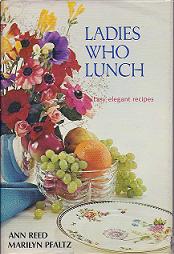
Ladies Who Lunch by Ann Reed and Marilyn Pfaltz
Published by:  Charles Scribner‘s Sons
© 1972
Recipe:  Sour Cream Soufflé – p. 40

And then there were two.

For 18 years, I was privileged to belong to a Ladies Lunch group of former co-workers from a data processing company I worked for from 1985-1994.  When I left, a bunch of us decided to meet and greet once a month at various restaurants in the Twin Cities metro area and the Ladies Who Lunch Bunch was off and running.

At first there were six of us, but then three others dropped out leaving me and my friends, Vicki and Arlene.  Of the three, I was the youngest although Vicki and I shared October as our birth month.  Arlene, the oldest of the three, but perhaps the youngest at heart, had just celebrated her 75th birthday in June.  It turns out that our last Ladies Lunch in celebration of her birthday would be our last.  Two weeks after that date, Arlene fell ill and was diagnosed with a malignant brain tumor.  Although the prognosis was initially positive, things took a turn for the worse and she died weeks later on September 3rd. To say Vicki and I and other former co-workers were stunned would be an gross understatement.  Arlene was just one of those people who seemed destined to outlive us all.

When Vicki and I first went to see Arlene in the hospital, we were shocked.  She was in pain, she was defeated, and we tried our best to rally her.  I was so discombobulated by my visit that when I left the hospital, I missed my exit back to my house.  Seconds later, I turned around but missed the exit again and then yet again until I finally gave up and took the longest route home (the one without any more exits), arriving 45 minutes later completely exasperated.  When I told that story to Arlene on my last visit, she laughed.

On our very last visit just a few weeks before she died, the difference in Arlene was astonishing.  She was back to her old self, holding court, laughing and telling stories.  When we worked together, Arlene was the Executive Secretary to our company’s CEO and she also held a command post, and I do mean command post, at the front reception desk.  Nobody worked a switchboard like her and when her always-manicured finger swept across the switchboard, it was like watching an elegant ballet.  For years and years, I teased her about that hand motion and she laughed; during the last visit, she asked me to mimic her so that some other visiting friends could see what she was like.  I did so with the greatest pleasure.

I also teased Arlene about the way in which she would track you down like a dog if you didn’t answer an overhead page.  If a customer called in asking for me and I wasn’t at my desk, she paged me.  At first it was polite – “Ann Verme, line 1.  Ann Verme, line 1 please.”  By the second time around, she was a little bit firmer in her request and oh my god, if you didn’t pick up after that, this is what you got:  ANN. VERME.LINE.1. ANN.VERME.LINE.1…PLEASE!!!!!”  I wouldn’t go so far as to say she was shouting, but you knew you had better haul ass and get the phone, even if you were stuck in the restroom.  The programmers, mostly male, used to joke that they came flying out of the restroom with the toilet paper flying behind them.  This image continues to make me laugh to this day.  

The other story that I told to the friends that were visiting Arlene on the last time I saw her was also one of my favorites about her.  Arlene was told by our company president to keep an eye on the supply cabinet and by god, she did.  As the sole holder of the cabinet key, she held a lot of power and I am not kidding when I say that she often made you show her your old pencil before deciding you were worthy of a new one:  “There’s still a little lead on that pencil,” she’d say or “You can still use that eraser, can’t you?” 

Even after deciding you were indeed worthy of a new pencil, you received one and only one brand new one.  Don’t ever kid yourself that in a wild moment she would give you two.  Several newcomers suffered from such delusions until we set them straight.

The drill when one was about to receive the new pencil/pen/what have you was always the same:  Arlene would put the switchboard on “transfer calls” and then would walk, slowly and stately, to the file cabinet, with the requestor walking behind at about five paces – kind of like the Duke of Edinburgh does with the Queen of England.  Heads were also respectfully bowed.  And then she would open the cabinet a mere crack, just enough to get her hand (never yours) in there and then would ask you again what you needed.  And out came the one pencil and you bowed appropriately and perhaps curtseyed and then she resumed her stately walk back to the front desk.  I tell you what she could have substituted for the Queen as she was just that regal. (And I love the Queen so…)

Well one day, toward the end of my time at the company, Arlene was busier than a bee and she didn’t have time to do the “perp” walk (I’m referring to all of us underlings, never Arlene) and so she handed me the key.  Oh.My.God. I got the key to the cabinet!!!  So I ran over to the programming department and said “You guys, you guys.  Arlene gave me the key!!!!”  And just like rats deserting a sinking ship, they fell in behind me and we ran with lightning speed to the cabinet.  This time around, the doors fell open automatically revealing quite the stash of supplies and let me just say that for one, brief shinning moment I swear we saw a glow and heard the most beautiful celestial sounds.  It was just like Christmas only better: “Look at all those notepads,” we chimed.  “Look at the pens – holy cow!”

You might think that with access to all those goodies we would have raided the cabinet but you would be wrong.  The one thing one did not do at that company was to get on Arlene’s bad side, a side she rarely displayed but you knew you were in deep doo-doo if she went there.  And so out of respect for the woman and out of fear for our work lives, I took the one thing I needed from the supply cabinet and with one last, longing look from me and from my coworkers, I shut and locked the door and walked back, as Arlene-like as I could to give her the key. 

Now some people might have walloped me over the head for retelling that story over and over again but Arlene loved it.  She was the quintessential Executive Assistant—loyal to her boss and to the company, gate-keeper (literally since our building was a secure building and she had to buzz you in if you didn’t have a pass), better than an attorney at keeping secrets and keeping her mouth shut, all-wise and all-knowing and above all, professional.  She would listen to your tales of woe but in the end she would often say quite simply and without a touch of snarkiness – “Well, if you don’t like your job here, perhaps you should find another one.”  Above all, Arlene wanted our workplace to be a happy, harmonious one and those years that we all worked at that company were just some of my favorites.  When we experienced a corporate take-over by a much larger company we grew bigger but experienced a lot of growing pains.  Our work family sort of fell apart and eventually we started experiencing a ton of layoffs, layoffs that Arlene knew about in advance but obviously couldn’t talk about.  A few of the layoffs pained her greatly and it wasn’t too long after I left that she decided to retire.  And out of those "ashes," the Ladies Lunch was born!

Being free from the confines of her Executive Assistant position didn’t automatically make Arlene sing like a canary but over the years, she shared her thoughts and insights with me and Vicki.  She was always so funny about how she did it, usually sweeping her gaze around the room to make sure there weren’t any “enemies” afoot and then lowering her head to deliver the dirt.  She would often start out lunch (really brunch-I cannot recall a time when we actually had lunch) by asking (hilariously) “Who has had a sighting?” By "sighting," she meant “of a former co-worker” and not UFO’s.  Just so we’re clear.  Then she would regale us with tales of work as well as family stories and friend stories that had me and Vicki doubled over.  She never thought she was that funny but she was and we told her that a thousand times over.  Vicki and I also told stories but somehow the stories always sounded better coming from Arlene.

Out of all the things that made Arlene unique, her thoughtfulness stood out as her number one best quality.  When she was invited to a party at my house, she always brought a hostess gift and frequently sent a thank-you note on note cards she made herself.  (She was also well-known for the fabulous jewelry she made after her retirement and at her funeral service, there was hardly a woman in attendance who wasn’t wearing a piece by Arlene.) When my parents died, she sent cards and when I lost one of my best friends of almost 32 years to cancer in March, she sent me a card for that as well.  And when Vicki and I took her out for her birthday lunch, she sent a thank you card out despite having thanked us in person.  It goes without saying that I’m keeping that one.

Now I’ve said before in this blog that I have a cookbook for about every occasion and wouldn’t you know, I already had this book on my bookshelf – Ladies Who Lunch – and so the day after her service, I made this wonderful Sour Cream Soufflé. If Arlene was alive, I know she probably would have tried it at home, likely saying “Well this was just delicious and so easy, too.” 

And so my dear Arlene, Vicki and I will soldier on with our lunches with the heaviest of hearts as we miss you already, and this special recipe is a final homage to you.  I know you were watching when I made it.  And I will never see a supply cabinet or a switchboard without thinking of you.  I do so hope that there’s a huge switchboard in the afterlife and that you are at the center of it all saying “God, line one.  God, line one please.”  It’s only fitting.

Sour Cream Souffle – serves 6
1 ½ cups sour cream
¾ cup sifted flour
1 ¼ tsp salt
¼ tsp pepper
2 tbsp chopped chives
½ cup grated (nonprocessed) Gruyere cheese (Ann’s Note:  I have no idea what nonprocessed cheese means!)
5 eggs, separated

Preheat oven to 350.  Thoroughly blend sour cream, flour, salt and pepper.  Stir in chives and grated cheese.  Beat egg yolks until thick and stir into the cheese mixture.  Pour into a 2-qt soufflé dish.  Place dish in a shallow pan of hot water and bake about 30-40 minutes or until puffed and set.  Serve immediately.

Ann’s Note:  I roasted some small yellow potatoes at the same time I baked this soufflé and tossed them in olive oil and sea salt for extra flavor.  I also served the soufflé with asparagus to add a little green to the plate.  Enjoy!


Thursday, September 13, 2012

"Lemonade for the Lawnboy - The Executives' Wives' Cookbook Committee" & "Corn - Meals & More" & "The Picnic Gourmet" - lemonade, chicken enchiladas and peaches with sweet cream cheese

Still Life: Mrs. Jonathan Hurlinger with martini glass


Date I made these recipes:  September 3, 2012 (Labor Day)

Lemonade for the Lawnboy – The Executives’ Wives’ Cookbook Committee by David W. Cook and Janet Letnes Martin
Published by:  Martin House Publications
ISBN:  978-1-886627-14-7
Recipe:  Mrs. Jonathan Hurlinger’s Thirst-Quenching Recipe for the Lawnboy –p. 5

CORN – Meals & More by Tastemaker-Award Winning Author Olwen Woodier
Published by:  A Garden Way Publishing Book Published by Storey Communications, Inc.
ISBN:  0-88266-456-5
Recipe:  Chicken Enchiladas – p. 78-79

The Picnic Gourmet by Joan Hemingway and Connie Maricich
Published by:  Vintage Books
© 1975, 1977; First Vintage Books Edition , June 1978
Recipe:  Peaches Stuffed with Sweet Almond Cream Cheese - 279


I don’t care if Labor Day typically signals the end of summer as we know it - when it’s time to make “Mrs. Jonathan Hurlinger’s Thirst-Quenching Recipe for the Lawnboy,” it’s time to make Mrs. Jonathan Hurlinger’s Thist-Quenching Recipe for the Lawnboy!

My friend, Lolo, gave me this hilarious cookbook, Lemonade for the Lawnboy – The Executives’ Wives’ Cookbook Committee, a while ago and I truly meant to make the lemonade recipe this summer but things got away from me.  So what if the temperature dipped down a bit by the time I made it?  When you’re thirsty, you’re thirsty and nobody appreciated it more than my own “lawnboy,” Andy.

This book is a total send-up of the classic society cookbook and by “society” I am referring to the Junior League cookbooks that have dotted the cookbook landscape for years now.  From Mrs. Biff Johnson to the fake Mrs. Jonathan Hurlinger, these ladies have submitted enough recipes to paper many a beach-front condo in Boca and then some while raising money for a good cause.  Good causes are a good thing.

Out of all the society ladies featured in this book, none drew my attention more than Mrs. J.H. who was, appropriately, pictured with her martini glass.  Aside from the fact that her green outfit would not look good against my skin tone, Mrs. J. H. and I could be twins as I do so love my martini.  I also think that the look on Mrs. J.H.’s face is quite similar to the look I wear when I am not amused, and lately people, I have not been amused.  (And this is why gin typically fixes everything.)  Lucky for me, Mrs. J.H’s lemonade saved the day.  It was simple, yet elegant and quite refreshing - quite.

By the way, here is my favorite description of Mrs. J.H –and funny how it describes me to a “t!” (This is from page 5 of Lemonade for the Lawnboy – The Executives’ Wives’ Cookbook Committee by David W. Cook II and Janet Letnes Martin.)

“…If that was not enough, the same week she threw a grand and most elegant birthday party for her dear friend, Mrs. Charles Chatterton.  Her devotion to details was unsurpassed, down to party favors of French crystal martini glasses etched with Mrs. Charles Chatterton’s favorite martini recipe.  Her brilliance and creativity is quite amazing.  It is no wonder she was chosen President of The Executives’ Wives’ Cookbook Committee.”

This lemonade paired quite well with my main course, Chicken Enchiladas.  Now people, I don’t know about you, but I expected this recipe to contain some corn seeing as how it came from a corn cookbook, but alas, no.  I re-read the recipe several times and even contemplated using frozen corn in the enchilada mixture but decided against it and instead opted for corn tortillas.  The book said I could make my own cornmeal pancakes but I had enough going on without having to pull another recipe together. 

While most of us are probably used to the “goopy” cheese-laden enchiladas served in most Mexican restaurants these days, this recipe didn’t call for cheese at all and that’s why I liked it, corn or no corn.  But the inclusion of this recipe in the (corn) cookbok, even if it was under “Ethnic Specialties,” still boggles the mind.

Last, but not least, was a (fresh) peaches dessert recipe taken from The Picnic Gourmet written by Joan Hemingway and Connie Maricich.  Joan Hemmingway is celebrated author Earnest Hemingway’s granddaughter.  (On my list of books to read is A Moveable Feast, written by “Papa” Hemingway in 1961 that recounts his days in Paris in the 1920’s and includes names and addresses of all his watering holes. (Somehow, this was one of the few Hemmingway books this English major did not read in high school or college.)

This book is divided into two parts.  Part one lists picnics by theme and contains menus for a Sunday Ski Picnic, a Boating Picnic (Oh darn, I forgot my boat-bummer) and an Italian Beach Picnic just to name a few.  The second half of the book contains recipe by category – soups, salads, fruit, etc.  As the title Picnic Gourmet suggests, this book does not contain your average Labor Day cook-out recipes of beans and weenies although many people would consider that “high end” picnic food if the beans were a mix of heirloom beans and the weenies were fancy stuffed sausages.  But although the recipes sound high end, many of them are pretty easy, like the recipe for Peaches Stuffed with Sweet Almond Cream Cheese.  Whew. 

All in all, this was a great meal to make on Labor Day and that’s a good thing as neither Mrs. Jonathan Hurlinger nor I like fuss or muss when it comes to holiday entertaining.

Mrs. Jonathan Hurlinger’s Thirst-Quenching Recipe for the Lawnboy – serving size not listed
1 cup water
1 cup white sugar
5 ounces of reconstituted lemon juice
1 ¾ cups ice water

Combine the water and sugar in a saucepan and bring to a boil.  Stir constantly until the sugar is completely dissolved.  Chill for 3 to 4 hours.  Pour the mixture and the ice water into a tall pitcher and add the lemon juice.  Cut the lemon into thin wedges and put them in a pitcher.  Stir the mixture and pour it into chilled glasses.  Add ice to each glass.


Chicken Enchiladas – yield:  4 servings
1 pound boneless chicken breasts
¼ cup chicken stock, tomato juice, or water
6 tablespoons cream cheese
2 tablespoons chunky Mexican sauce (salsa) (mild or hot)
1 tablespoon vegetable oil
1 small onion, chopped
3 cloves garlic, crushed or minced
1 28-ounce can crushed tomatoes (3 cups)
1 3 ½ -ounce can green chili peppers, chopped
1 teaspoon ground coriander
¼ vegetable oil
8 6-inch tortillas
1 ½ cups sour cream (optional)
¼ cup chopped chives or scallion greens (optional)

Preheat the oven to 400F.  Put the chicken breasts in a skillet, pour in the stock, cover and simmer for 10 minutes.  Reserve 1/3 cup of the liquid.  Thinly slice the chicken breast.  Blend the cream cheese, reserved liquid, and Mexican sauce together.  Stir in the chicken strips.

While the chicken is poaching, heat the 1 tablespoon oil in a large skillet and sauté the onion and garlic for 2 minutes.  Add the tomatoes, chili pepper, and coriander.  Simmer for 15 minutes.

Heat the ¼ cup oil in a skillet and drop each tortilla into the hot fat for about 10 seconds.  This is not to cook them but to make them pliable.  (Note:  this did not work well at all for the corn tortillas as they were too soft.  My guess is that this method would work well for flour tortillas.)

Remove immediately to a baking dish measuring approximately 12” x 9” x 2” and spoon 2-3 tablespoons of the chicken mixture along the center of each tortilla.  Roll up and place seam-side down in the dish.  Repeat until all tortillas and the filling have been used up.

Spoon the tomato sauce over the top and bake for 15 minutes.

Mix the sour cream and chives and spoon over each cooked tortilla.


Peaches Stuffed with Sweet Almond Cream Cheese – serves 6
3 large peaches
½ pound cream cheese
3 good macaroons, crumbled in a blender (or three biscotti or other “hard” cookie)
1 teaspoon ground almonds (grind in blender)
Peach pulp from seed cavities
Fresh mint leaves (optional)

Choose large ripe peaches, and scrub the outside skin.  Cut each peach in half, take out the seed, and enlarge the seed cavity with a spoon.  Reserve the peach pulp taken out.

Mix the rest of the ingredients in a small bowl.  [If going on a picnic] Pack the peaches and filling separately.  To serve, place a teaspoonful of filling on each peach center.  Garnish and decorate the plate of filled peach halves with fresh mint leaves. 

Ann’s Note:  this last line just makes me hoot:  [mint leaves] “These can usually be picked on the trail or at the picnic site.”  Hahahahaha……Hardly.

**Both Corn and The Picnic Gourmet were purchased at the Bloomington Crime Prevention Association Sale held in June.

Saturday, September 1, 2012

"It's the Berries!" - Chicken with Strawberry Vinegar and Honey


Date I made this recipe:  August 26, 2012

It’s the Berries!  - Exotic &Common Recipes by Liz Anton & Beth Dooley
Published by:  A Garden Way Publishing Book; Storey Communications, Inc.
© 1988
Recipe:  Chicken with Strawberry Vinegar and Honey – p. 39; Strawberry Vinegar recipe p. 142

If last week’s problem with blog posting was procrastination (i.e. having too much time on my hands), this week’s problem was a concerted lack of time.  I could not carve out even a second or two to write this thing and that was frustrating because this dish is delicious and I couldn’t wait to tell you all about it. And it’s also redemption for the sad meal I made the week before.

I’d love to say that summer is the period where I stock up on fresh (and seasonal) fruit and vegetables but alas, I do not.  I have yet to visit a farmer’s market, operating under my own, personal premise that “You’ve seen one, you’ve seen them all” and I basically ignore everything in my grocery store that screams “Seasonal!”  It’s not that I don’t love fruits and veggies, I do, but it’s just not something that comes to my first thing in the morning.  Coffee comes to mind first thing in the morning, followed by nap, followed by….

Until this past week, that is.  I recently purchased this book, It’s the Berries!, from Arc’s Value Village Thrift Store and while putting it away in my stack, I thought “Huh, maybe this would be a good time to make something from this book.”  I was not wrong.

But I will say that finding the right recipe was a challenge.  Several recipes contained cranberries and it is way too early in the season for that.  I don’t like fruit soups (personal preference) and dessert seemed so clichéd.  But then I spotted it.  Strawberry chicken!  With honey! Strawberry chicken AND honey!  Sweet!  (Pun intended).

And so I made it and so it was good and so I was happy.  I served this up with couscous and asparagus and my oh my, what a fun meal I had. (Well, I overcooked the asparagus but these are the things we must deal with in life.  I ate it anyway.)

BUT.  Let me be clear that should you make this dish (and you should), do not, I repeat, do not use those craptastic things in the grocery store that masquerade as strawberries.  To do so is an insult to the real deal and your dish won’t be as flavorful.  Because folks, the way strawberries are genetically engineered these days robs them of their flavor.  Bite into one and it’s like biting into colored Styrofoam but that is just this gal’s opinion.

I say this to you because people, I’ve had the “Real Deal.”  My parents had a fruit and vegetable garden and all summer long, we feasted on earthly delights such as raspberries and strawberries.  Compared to today’s gigonzo strawberries, our little garden ones seemed so anemic yet they were loaded with flavor.  We had strawberry jam, strawberry compote and frozen strawberries to last us a lifetime.  Ah, such sweet memories!

At any rate, I bought my strawberries at Trader Joe’s and while larger than I liked, they were close enough to the “Real Deal” for me to buy them.  Plus, they were reasonably priced and so that made me feel all the better about skipping out on a farmer’s market excursion to find something comparable to what I had as a child.  So there!

So the order of appearance in this recipe is that you make the strawberry vinegar first and then…uh oh…let it steep for a month, and then use the vinegar in the recipe.  Well I can assure you that didn’t happen!  But I am happy to report that this was no big deal.  In fact, instead of straining the vinegar, I threw some of the mashed strawberries from the vinegar mixture into the skillet and the result was yummy.

As to the authors, Minnesota cook book collectors might recognize Beth Dooley’s name from a couple cookbook s as well as a byline in the Mpls St. Paul Magazine.  Beth’s newest cookbook, The Northern Heartland Kitchen, focuses on seasonal cuisine in this neck of the woods but I first knew Beth when she teamed up with local chef and restaurant owner (and my hero), Lucia Watson, to write one of my favorite books in my entire collection (1,463 and growing) – Savoring the Seasons of the Northern Heartland.   This book also focuses on local cuisine and features the same type of food that is regularly featured as Lucia’s restaurant called, appropriately, Lucia’s in the Uptown area of Minneapolis. (Go.there.now.)  Beth wrote this cookbook, It’s the Berries, with her mother, Liz Anton and I think it is very cool that mother and daughter got along well enough to put pen to paper to create this cookbook; my sister-in-law loves a photo of me and my mother arguing in the kitchen at Christmastime, 1996.  So there you have it.

As we are now on the doorstep of Labor Day, I urge you to get going and make this recipe!  And get “Real Deal” strawberries and don’t think I’m kidding.  You will thank me later.

Chicken with Strawberry Vinegar and Honey – serves 8
4 pounds of chicken, quartered
Salt and pepper to taste
2 tablespoons clarified butter *see notes below
2 tablespoons peanut oil, plus some to sauté shallots
4 shallots, minced
½ cup strawberry vinegar
1/3 cup honey
1 cup strawberries, hulled and rinsed or if frozen drained and thawed, sliced

For the strawberry vinegar – makes 5 cups
2 cups strawberries
1 cup of champagne and 1 cup for later (optional)
2 cups white wine vinegar
8 whole black peppercorns
1 ½ teaspoon sugar

To make the vinegar:
Mash strawberries.  Heat the champagne, wine vinegar, peppercorns and sugar together.  Pour over strawberries in sterile jar.  Cool, cover and place in a dark place for a 1 month.  Stir occasionally.  Press out strawberry flesh between double cheesecloth, discard the fruit.  Add the second cup of champagne to the vinegar mixture.  Stir to release the carbonation.  Allow to rest in a dark place for 1 month.

Ann’s Note:  I pretty much ignored everything above, some of it intentionally, some of it not.  I mashed the berries, skipped the vinegar and skipped the cheesecloth portion of our program and for sure did NOT let it sit for a month but it was still tasty.  I also cut down the portion size to equal one cup (or so) and it worked fine although I added a little bit more sugar than was called for but that was to satisfy my own personal taste.

To make the dish:
Rinse and dry chicken.  Sprinkle with salt and pepper to taste.  Combine butter and oil in large skillet, add chicken and brown.  (Do not crowd pieces.)  When chicken has been browned, remove to a warm platter with pan juices.  Skim fat.  Sauté shallots in a small amount of oil until translucent.  Add strawberry vinegar and honey to pan and simmer.  Return chicken, cook until partially covered for about 20 minutes.  Baste often to glaze chicken.  Toss in strawberries just before serving.

Ann’s Note:  I used boneless skinless chicken breasts, cut in half, so there wasn’t any fat to skim.  I also added a bit more oil to the pan as well as more honey and more strawberry vinegar (with mashed strawberries) as the sauce was looking like it might stick and burn.  And then I tossed in the strawberries with about 5 minutes left just because I like to go rogue.  The result was phenomenal!


Sunday, August 26, 2012

"Good Things to Eat - As Suggested by Rufus (Rufus Estes -former slave)" & "Clambakes & Fish Fries" - Corn Fritters and Oyster Pan Roast


Date I made these recipes:  August 19, 2012

Good Things to Eat as Suggested by Rufus by Rufus Estes – Published by Rufus in 1911; edited by D. J. Frienz
Facsimile of this book Published by Howling at the Moon Press
ISBN: 9-9654333-1-5
Recipe:  Corn Fritters – p. 61-62

Clambakes & Fish Fries by Susan Herrmann Loomis
Published by:  Workman Publishing, New York
© 1994
Recipe:  Oyster Pan Roast – p. 133-134

People, I am not a procrastinator by nature but I have been putting off posting this blog forever, probably, in part, because the meal wasn’t my best effort.  Although I rarely have clunkers, this definitely landed in that category and that makes me sad.  Food should be pleasing, no?

Initially, I planned to celebrate the end of the Olympics by preparing this meal.  But if you are like me, I was too exhausted to cook anything to celebrate the end of the world’s greatest sporting event.  And besides, the closing ceremony started early in the evening and who wanted to be in the kitchen (never mind that I have a TV there) during the closing ceremonies? (That said, NBC – please don’t announce the The Kinks and The Who are “coming up” if you don’t plan to show them.  Did we really need to see the pilot to Animal Planet/Animal Practice/Animal Whatever?)

Now, I am not normally glued to my set 24-7 during the Olympics, but this time was different.  Certain events have always grabbed my attention like swimming and track and yet there I was all fist to my mouth watching the equestrian Individual Jumping competition with the horses (and riders, natch) clearing (or not) all those bars and water hazards and whatnot.  And although I can often take or leave gymnastics (I know – heresy) I often find myself watching through my fingers as the gals do the balance beam.  I’m sorry, there’s just nothing on this planet that will make me do back flips on a 4” piece of wood - nothing.

At any rate and any who, one of the bright stars of the Olympics was of course Gabriel (Gabby) Douglas, the first African-American to win gold in the All-Around (Gymnastics) Competition.  I wish I had that gal’s enthusiasm and bubbly personality.  She was just a joy to watch, and I think we can all agree, not half bad in her events, right?!

So as I was watching her tumble and flip and twirl her way to a gold medal (and let’s not forget the team gold, either), I started pondering what cookbooks I could use to celebrate her breakthrough stardom.  And then it hit me – years ago, I acquired a cookbook written by a man who was born a slave but went on to have a career as a Pullman (train) chef and thought that would be perfect – a breakthrough star doing an unheard of “professional” job  in the early 1900’s.

Rufus Estes was born a slave in Tennessee in 1857 and was given his name by his slave master, D.J. Ester.  D.J. owned Rufus’ mother’s family:  does that not give you chills?  After the Civil War ended, he did odd jobs around his grandmother’s house before finally getting a job in a Nashville restaurant at age 16.  In 1883, he started working for Pullman and remained there until 1897; during that time he waited on everyone from African explorers to two Presidents of the United States - Grover Cleveland and William Henry Harrison.  Eventually, he became a chef for one of U.S. Steel’s subsidiary companies in Chicago and shortly thereafter wrote this cookbook.  He also penned the biography found in the front of the book. In 1999, a facsimile of his original book was published and the cookbook literary world took note – a cookbook penned by a former slave?  In 1911?  What?!

Not only did he write this cookbook but in terms of recipes it’s pretty comprehensive.  There’s a recipe in this book for homemade English Muffins and yet another for candied violets.  Well color me impressed because I am!

I decided to make his recipe for corn fritters as it was fairly easy and it is sweet corn time right now so I had a hankering.  But corn fritters alone didn’t seem like much of a meal and so I decided to make a seafood dish in homage to Gabby Douglas’ home town of Virginia Beach, Virginia thus the pan-roast oysters.  I’ve been to Virginia Beach many times in the past and had some delicious oysters there and so thought “Why not?”  Now hard could that be, anyway?  Answer:  harder than you think!

Clambakes & Fish Fries, my source for the pan-roast oysters, includes fish and seafood recipes from all over and since both Rufus and Gabby traveled all over in pursuit of their dreams, I thought a recipe from this book would be good.  Plus, truth be told, I’m not sure I have a Virginia seafood cookbook – yet.

Okay, so corn fritters and pan-roast oysters it was and so a week after the Olympics (now that I had time), I set about to get ‘er done.  Well.  I don’t know what I was expecting with the fitters but they came out like pancakes and let me tell you, flipping a pancake loaded with corn kernels is challenging.  The recipe said to let them cook for 4-5 minutes on each side but had I done that, we would be having charred corn—and this is not necessarily a good thing.

But the worst disaster was the oyster pan-roast.  This recipe said to fry for 1-2 minutes on each side and this was just wrong on so many levels.  I went longer than that but still ended up with kind of a mushy, warm oyster that was neither raw nor roasted.  But if I went too long, I worried that I would end up with erasers (trust me, this happens) and didn’t fancy eating erasers for dinner. 

So, what we ended up with was a corn pancake that needed way more salt and pepper than the recipe required and some mushy, warm oysters without much flavor to recommend them.  Can I just tell you that this is why keeping microwave popcorn on hand is a good idea?

Despite the culinary “failure,” I would attempt both dishes again but this time with variations:  maybe a pinch of cayenne pepper added to the fritters? How about maple syrup on top since they resemble pancakes? Or maybe a bit of white wine or vermouth added to the oysters?  The sky is the limit.

I do not regret though, having made recipes from these books, especially Rufus’ because it gave me a chance to re-read his crowning achievement and put it in perspective next to his modern-day “breakthrough” equivalent – Gabby Douglas’ gold medal.  While I am happy and proud of Gabby’s accomplishments, doesn’t it seem a little unreal that it took until 2012 for this to happen?  And yet- world events from the Civil War to the Olympics reminds us every time that life is a constant cycle of triumph over tragedy.  For Rufus, it was breaking out of his slave beginnings to carve out a life as a chef and to publish a cookbook.  For Gabby, it was leaving home and family behind in Virginia to train in West Des Moines, Iowa and then prevail over all the other gymnastic Olympic hopefuls to win a spot on a team.  I tell you what, just to make the Olympic team is an accomplishment in and of itself and something this aspiring couch potato does not take lightly!!

As a final thought, I was thinking that in some ways the failure of these recipes mirrors the efforts that fell short by most 2012 Olympic athletes including Gabby in some of her individual events. As my father always said “Many are called, few are chosen,” and so despite making the Olympic team, most athletes walked away without a medal. Watching the “agony of defeat” (thank you ABC’s Wild World of Sports!) is heartbreaking and yet it’s something that most of us experience – painfully – in our own lives every day. The moral of that life story is classic: “If at first you don’t succeed, try, try again.”  I can assure you that I will live to cook another day!

So here’s to our breakthrough stars and their breakthrough moments. 

Corn Fritters – serving size not listed (I made half a recipe)
4 ears corn
¼ pound (sifted) flour
Two eggs
½ pint cold milk
Salt and pepper to taste
Butter for the pan

Prepare four ears of fresh corn by removing the outer husks and silks; boil and then drain well.  Cut the grains from the cobs and place in a bowl, season with salt and pepper, add one-fourth pound of sifted flour, two eggs and a half pint of cold milk.  Stir vigorously, but do not beat, with a wooden spoon for five minutes, when it will be sufficiently firm; butter a frying-pan, place it on a fire, and with a ladle holding one gill put the mixture on the pan in twelve parts, being careful that they do not touch each other, and fry till [until] of a good golden brown color, cooking four or five minutes on each side.  Dress them on a folded napkin and serve.

Ann’s Note:  a “gill” is one-half cup.


Oyster Pan Roast – 8 appetizer servings (4 main-course servings) – I made half the recipe
8 tablespoons (1 stick) unsalted butter
4 cloves garlic, minced
1 ½ pounds (about 48) freshly shucked oysters
*I bought my oysters at Coastal Seafood in St. Paul

Melt the butter in a large skillet over medium-high heat.  Stir in the garlic, and cook until the butter foams and the garlic begins to turn slightly translucent, 1 to 2 minutes.  Then add the oysters and cook, stirring constantly or shaking the pan, until they are plump and beginning to curl at the edges, 1 to 2 minutes.  (Ann’s Note:  1-2 minutes does not seem like sufficient time.  After 4 to 5 minutes, I still had quite the gloppy mess on my hands.)

Turn the oysters out into a warmed serving bowl or individual bowls, and serve with plenty of crusty bread. 

*PS--I purchased this book, Clambakes & Fish Fries at Arc's Value Village in Richfield, MN for mere pennies on the dollar.