Showing posts with label corn. Show all posts

Friday, October 7, 2016

"Fork in the Road" - Michigan Culinary Adventures From the Emmy Winning PBS Series" - Michigan Double Sweet Corn Chowder


Date I made this recipe:  October 5, 2016

Fork in the Road – Michigan Culinary Adventures from the Emmy Winning PBS Series [Fork in the Road] with Eric Villegas
Published by Huron River Press (Ann Arbor, Michigan)
ISBN: 13: 978-1-932399-17-2; © 2007
Purchased at Canterbury Book Store in Escanaba, Michigan on a trip back to my home state
Recipe:  Michigan Double Sweet Corn Chowder- p. 98; Roasted Garlic Puree – p. 88

Last week, I returned to my home state, Michigan, to have an early birthday celebration with my Aunt Mary, who will be 95 years old next week. My birthday is the day before hers and we have always been thick as thieves so it was great to see her to "pre"-celebrate.  She rode shotgun with me on trips to into town as well as one longer one to Traverse City to deal with a rental car issue.  Make that issues, plural, but that's another story for another day.

And while we were traversing Traverse City (and greater Traverse City), we stopped to eat and had a nice chat with our server who said that he was originally from "The Soo," which translated means "Sault Ste. Marie, Michigan" (or, but not in this case, Sault Ste. Marie, Ontario, Canada). 

The Michigan "Soo" is located in the Upper Peninsula.  Although Aunt Mary has lived "downstate" (i.e. the lower peninsula) for many years, she was born and raised in the Upper Peninsula as was I.  We informed our server of this cosmic connection, and it is cosmic in that it a rare thing to find three people hanging out "downstate" who can all lay claim to having Upper Peninsula roots.  So that was fun.

Anyway, I was hoping to have time to scrounge around for a Michigan cookbook to commemorate this trip, but I did not and so I pulled what I think is the last of my Michigan cookbooks off the shelf and set to work. 

This cookbook is based on the PBS show, Fork in the Road, and is all about Michigan.  The author, who is also the show's host, showcases Michigan foods by regions and then makes recipes using these foods.

As a native to the state, I am very familiar with some of these "native" incredible edibles such as whitefish, cherries and blueberries.  Naturally, the author suggests using "Michigan" ingredients for many of these dishes but that was pretty impossible.  For one thing, I am not hauling whitefish on a plane with me (plus, you'll mostly find it in Lake Superior in the Upper Peninsula) and it was way too late for blueberries and cherries.  You should know that the area I was in, Traverse City, hosts the National Cherry Festival every July (1st part) and you cannot turn around in that town without spotting a cherry "whatnot," regardless of whether or not the festival is in full swing. In fact, I am quite enjoying some hot coffee in my "Traverse City – Cherry Capital of the World" mug as we speak! 

The book is broken out into recipes by region:  "Freshwater;" "The Fruit Belt;" "Middle of the Mitt" (i.e. the lower peninsula); "The Thumb" (the area along Lake Huron's lakeshore, home to such cities as Port Sanilac and Port Huron (I've been to both); "The U.P." (my home turf), and then "Great Lakes Pantry," which features side dishes, spices, vinaigrettes, and other items used in cooking.  That said, I'm not sure these are necessarily native to Michigan but we'll run with it.

Recipes from these regions are as follows:

Freshwater:
  • Freshwater Whitefish Chowder with Bacon, Potatoes and basil – p. 15
  • Smoked Whitefish Nachos with White Cheddar, Smoked Tomato Salsa and Cilantro – p. 19

The Fruit Belt:
  • Balaton Cherry and Michigan Maple Crisp – p. 50
  • Barbecued Pork Ribs with Blueberry Chipotle Chile Rub and Blueberry Mop – p. 55

Middle of the Mitt:
  • Grilled Ears of Michigan Sweet Corn with Black Truffles – p. 95
  • Michigan Beer Bread – p. 96
  • Michigan Double Sweet Corn Chowder – p. 98 (featured recipe)

The Thumb:
  • Maple Sage Breakfast Sausage – p. 140
  • Michigan Steamed Brown Bread with Dried Cherries and Walnuts – p. 144
  • Maple Corndogs – p. 147

The U.P.:
  • Beef and Pork Pasty with a Classic Suet Crust – p. 166
  • Michigan Maple Spice Rub – p. 157
  • Maple Chocolate Truffles – p. 169

A few of these sections need an explanation:

If you live along Lake Superior (in either the Upper Peninsula of Michigan or the Duluth area of Minnesota), then you probably know that Whitefish is considered the poor man's lobster.  I am not fond of fish so I don't eat it, but the rest of my family loved it.  There is hardly a restaurant in these regions that doesn't have it on the menu.  Even though many of you won't be able to get your hands on Whitefish, you might want to try some of these recipes with a comparable fish from your area.  Check out Google for a home-turf equivalent.

Another wildly popular food from the U.P. (if not the most popular) is the Cornish pasty (pronounced pass-tee).  The Upper Peninsula (and northern Minnesota) is big into mining (of iron ore) and immigrants came from all over to work the mines.  The Cornish pasty was popular in the mining community but then caught on throughout the region. Today, you will find pasty shops everywhere and if you are traveling the area and find one, give it a try.

The crust for this recipe (which I did not try) is  made with a traditional suet crust but I've eaten plenty in my day that were made from vegetable shortening or lard and all was well.  Where disputes arise is the filling (rutabagas or not) and whether or not a pasty should be eaten with gravy, ketchup, or plain.  We were always a "ketchup" family as a pasty is really like a meat and potato casserole/meatloaf, wrapped in crust. 

Then there's the "Fruit Belt" of the lower peninsula.  The area I was just in, Traverse City (and environs) is the cherry capital of the world.  Also found in the "Fruit Belt" (as well as the U.P.) are blueberries and maple trees that yield maple syrup.  My dad used to tap the trees on our property to make syrup, and we also went blueberry picking several times when I was a kid.  Rounding out the fruit selection are recipes featuring Michigan apples.

As to the corn chowder I made, of course the recipe suggested using Michigan sweet corn, but alas, I used up some Iowa sweet corn brought to us by friends this summer.  I am no corn connoisseur but I doubt anyone could tell the difference.

So, with cheating on my mind (!), I set to work making this dish and I have to tell you that it failed because I failed.  The chowder itself is really flavorful and very good but I screwed up the corn situation and it was basically inedible. 

Here's what happened:  twice now, our Iowa friends have given us corn (Thanks, Doug and Emily!) and twice I've frozen it on the cob.  Methinks I should have blanched the corn or something but I didn't because what do I know? And so twice it ended up being soggy when I thawed it – no surprise, right? 

So this time around, I decided to try to dry the kernels by spreading them on a baking pan and setting my oven to 275.  When that didn't work, I thought maybe I should roast the kernels and so I put them in the oven at 425 just for a short period of time but by then, it was too late.

I was bereft.

Naturally, I should have looked online to see if I could find instructions, but I thought my solution would work.  It didn't.  As Andy said "Well, this is how we learn."  Ha!

So here's my advice to you if you make this dish (which you should because everything else was delicious):  1) if you use sweet corn (and the dish calls for you to add the de-kerneled cobs to the  chowder), do it when the corn is fresh, period, end of discussion. 2) if you cannot do that and want to make this dish, use frozen corn (proportionate to what you would remove from the cob) and cook it as directed.  And this is because 3) even though the recipe says to pour the hot chowder broth over the raw kernels to cook them, I am not sure that will happen unless you are using fresh kernels.  That said 4) the only ingredient in this chowder's "broth" is cream.  That's it.  My cream simmered nicely but it also thickened which is fine for the end result, but not so much to cook the kernels – at least in my completely inexpert opinion, emphasis on the "in."

I found I wanted to add chicken broth or water to the chowder so it was less thick but did not as I almost always stick to the recipe and the recipe said to use cream (and only cream).  You might want to tinker with it.

Finally, this recipe calls for you to use 1 tablespoon (less, if you make half the recipe as I did) of Roasted Garlic Puree, found on page 88, but you have to roast a lot of garlic for that 1 tablespoon and I didn't want to deal with it.  So here's what I did instead:  I caramelized one small onion along with some sliced garlic cloves, then pureed that and added it to the dish.  Worked just fine without the added fuss of roasting garlic.

And so kids, if you rework the recipe for either fresh corn or frozen (but cooked) corn, I think this might work. Heck, you could probably even use canned corn because who's going to know? 

After we picked our way around the corn, Andy suggested that maybe I could try again but I am not that fond of corn that I wanted to do so and so I passed.  Besides, I know where I sinned and shall now say the kitchen equivalent of  five Hail Mary's and move on.   And if you don't want to make corn chowder, there are plenty of other delicious recipes in this book with fabulous photos to boot (I am so hungry right now).

This concludes "Michigan, My Michigan," a look back at my home state and the fond memories I had of living and touring it.  As an aside, many people (including me) think that "Michigan, My Michigan" is the name of our state song but it isn't. According to Wiki, the state song is just "My Michigan."  I can see why there is confusion though, as the lyrics say "Michigan, my Michigan..." over and over but details, details.


Michigan Double Sweet Corn Chowder – serves 4
4 tablespoons unsalted sweet butter
1 cup white onions, peeled and diced
½ up leeks, white part only, diced
1 tablespoon Roasted Garlic Puree (recipe below) Ann's Note:  or substitute caramelized onions and garlic – see below
½ pound red skin potatoes, washed and sliced
*9-10 ears ultra fresh double sweet corn, preferably from Michigan, shucked, kernels removed, reserving "bones" (ears) *Ann's Note – Important see notes above and below about the corn situation
3 ½ - 4 cups heavy cream
Sea salt, to taste
Clancy's Fancy Hot Sauce, or similar, to taste
½ small lemon, juiced

For the roasted garlic puree – makes about 1 cup (of which you need ½-1 tablespoon)
1 pound fresh hardnecked garlic, whole heads or similar
½ cup extra virgin cold pressed olive oil
Sea salt, to taste
Black pepper, freshly ground, to taste
Fresh rosemary sprigs

And if you want to skip that, you can caramelize one small onion and a couple of garlic cloves (sliced) and then puree that.

To make the garlic puree:
Preheat oven to 375 degrees F.

Peel the outermost layers of skin off the heads of garlic leaving an intact whole head free of any scrap.  Split the heads in half (horizontally) opening the cloves.  Put the heads, cut sides up, in a small baking dish and pour the olive oil over them.  Season with salt, pepper, and top with the rosemary.

Cover tightly with foil or lid, place in the oven, and roast until about three-fourths cooked, about 45 minutes.  Uncover and return to the oven until the cloves begin to pop out of their skins and brown, about 15 minutes.

When cool enough to handle easily, squeeze the roasted garlic into a small bowl.  Press firmly against the skins to extract as much of the sweet roasted garlic as you can.

Add the oil from the baking dish and puree with the back of a spoon or in a small food processor until a paste forms.

Store, tightly covered, in the refrigerator, for up to 1 week.

To make the chowder:
In a 3-quart saucepan, melt the butter; sauté the onions and leeks over a moderate heat until translucent and wilted, about 10 minutes.

Add the Roasted Garlic Puree (Ann's Note:  or pureed caramelized onions/garlic mixture or skip this all together!) and the sliced red skin potatoes.  Cook for another 3 minutes or until the potatoes are warmed and completely coated in the butter.  Add the heavy cream, "corn bones" and season with the salt and hot sauce.

Simmer for 20 to 30 minutes or until the potatoes are tender and the "bones" have released their flavor.  Remove and discard the "bones."

***Place the rest of the raw corn kernels in the bottom of a soup tureen and pour the hot soup base over all, season to taste with the lemon juice.  Serve immediately.

***Ann's Note:  Since I screwed up the corn portion of our program, let me just remind you that to achieve the results above, use fresh corn otherwise, frozen but cooked corn is probably your best bet.  I just didn't think the "hot soup base" was hot enough to cook the corn but that's just me.  I also think the base was too thick and needs more than just cream but that's not what the recipe says!


If you get the corn right though, this chowder will be a home run instead of a slight swing and a miss.

Sunday, December 28, 2014

"The Thanksgiving Book" - Country Corn Chowder - Christmas Day soup


Date I made this recipe:  December 26, 2014

The Thanksgiving Book – An Illustrated Treasury of Lore, Tales, Poems, Prayers and the Best in Holiday Feasting by Jerome Agel and Jason Shulman; Introduction by Willard Scott
Published by: Dell
© 1987
Recipe:  Country Corn Chowder – p. 23

Just like this year's Christmas cards (still unsent), I intended to make this dish on Christmas Day.  But we were invited to a Christmas open house and when one thing led to another, we got home way too late to assemble this soup and so you're getting the recipe the day after.  From a Thanksgiving cookbook, no less.  Well – these things happen.

This year, our Thanksgiving and Christmas holidays were very low key which is fine by us as we merely switch our meals around to fit schedules.  Actually, this year, Thanksgiving came and went without so much as an overeating moment to our name.  We normally spend the time around Thanksgiving with members of Andy's family but this year everybody was scattered and so to keep things simple, we got a turkey dinner takeout from one of our favorite restaurants.   And for the first time, it was rather underwhelming so...huh.

So then Christmas time was upon us and we were once again faced with dinner(s).  This time around, we decided that our usual and customary pasta meal on Christmas Eve would be our big meal and since we had the open house on Christmas Day, a simple soup would serve as dinner.  And since friends from Iowa came bearing gifts of sweet corn to us this summer (that we then froze), we decided on a simple but good corn chowder.  And naturally, the recipe came from a Thanksgiving book, reminding us of what we missed this time around.  And by the way, since his mom is having an open house on New Year's Day, we are going to do the same drill we did this Christmas i.e. heavy meal the night before, soup the day of.

So.  Corn Chowder is one of our favorite soups and as soon as our friends gave us the corn, Andy suggested making it but of course, we didn't have the time or I, the inclination, to go searching for a chowder recipe.  And then Thanksgiving came along and the thought of finding recipes for all the components of a traditional dinner (turkey, stuffing, etc.) was so overwhelming that we opted for take-out.  Still, I flagged this recipe with the frozen corn in mind.

And so speaking of the corn, although this recipe doesn't require you to pre-cook the corn, neither does the cooking time allow for it to get good and done (if you are using frozen corn that is).  So I recommend taking the corn off the cob and then cooking it (either in a pan with water or a microwave) until it's a little tender and then adding it to the soup.  Andy though, said he preferred the texture of the corn "as is" and so he wouldn't change a thing.  But it's my blog so I win!

I also made two additions to the recipe that I hope won't get me sent to culinary hell:  a bit of leftover red pepper – diced, and then two chicken breasts that I poached and then diced.  I love chicken corn chowder but you won't go wrong if you make the recipe as is.

Country Corn Chowder – Yield 8 to 10 servings
Per our authors, this recipe was a house specialty from the Inn of the Golden Ox, in Brewster Massachusetts.  (www.goldenox.com)

½ lb bacon or fatback, diced (Ann's Note:  This is not used to complete the recipe, only to sauté the vegetables so if you don't have enough or even either on hand, don't sweat it!)
1 large Spanish onion, diced
1 cup celery, diced
½ cup flour
2 qt chicken stock, chilled
2 cups raw potatoes, diced
½ tsp thyme
1 bay leaf
½ tsp marjoram
4 sprigs parsley
6 peppercorns, crushed
1 clove garlic
6 ears sweet corn
2 cups half-and-half or light cream
Salt to taste
White pepper to taste
Unsalted butter (for garnish)

In a 4-quart stockpot, sauté bacon or fatback until fat is rendered.  With a slotted spoon remove bacon or fatback and discard, leaving fat in the stockpot.  Add onion and celery, and sauté until transparent.  Do not brown.  Sprinkle vegetables with flour, stir, and continue to cook over low heat for 10 minutes.  Do not brown.  Add chilled chicken stock and bring to a boil, stirring constantly.  Reduce to a simmer and add potatoes.  Tie thyme, bay leaf, marjoram, parsley, peppercorns, and garlic in a cheesecloth and add to simmering soup.  Remove corn from cob with a sharp knife; add corn to soup.  Simmer until potatoes are tender.  Add half-and-half or light cream and return to simmer.  Season with salt and white pepper to taste.  Ladle into soup bowls and garnish with a dollop of butter.


 If you want to add poached chicken, place chicken breasts in a pan of cold water, and cover with water.  You'll need about an inch of water above the breasts for proper poaching.  Bring the water to a boil, then turn the heat down to simmer, cover and cook for about 8-10 minutes.   Slice and dice as needed!

Friday, August 8, 2014

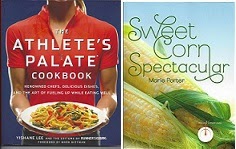
"The Athlete's Palate" (by Runners World magazine) and "Sweet Corn Spectacular" - Orange Cumin-Glazed Pork Tenderloin and Roasted Corn Chowder


Date I made these recipes:  August 3, 2014

The Athlete's Palate Cookbook – Renowned chefs, delicious dishes, and the art of fueling up while eating well by Yishane Lee and the Editors of Runner's World®; foreword by Mark Bittman
Published by:  Rodale
ISBN:  978-1-60529-578-7
Purchased at Arc's Value Village Thrift Stores
Recipe:  Orange-Cumin Glazed Pork Tenderloin – p. 114

Sweet Corn Spectacular by Marie Porter
Published by:  Minnesota Historical Society Press
ISBN:  978-0-87351-892-5
Purchased at:  Half Priced Books Tent Sale
Recipe:  Roasted Corn Chowder – p. 66-67

So a couple of months back, my husband, a biking aficionado, got the bright idea that if riding a couple 200K bike rides was good, a 300K (185 miles) bike ride was better!

We are both here to tell you that this was not exactly a great idea.  In fact, it could have been disaster.  It wasn't, but we're both going to file that under "Don't do this again – ever" and leave it at that.

Because folks, here's the thing:  this 185 mile bike ride took 16 hours, 15 of which were in "the saddle" and maybe an hour or so was allotted to rest stops.  That's just cuckoo crazy!  Fifteen hours doing nothing but riding a bike – say what?  My butt hurts thinking about that.  The ride started at dawn-o-clock and he finished up around 11:30 p.m.  I was a tad nervous about him riding in the dark and so when he called me to say he was back at his car, I was relieved and so was he! 

Now, unlike Andy, I like to go for a walk rather than ride a bike but even then, I don't think I've ever logged 185 miles per year.  Not even half that.  So the effort is commendable to be sure.

So...what to feed an athlete about to do "battle" with his bike?  Well, for a wide variety of recipes, some geared for training, some geared for recovery, you should look to The Athlete's Palate Cookbook, published by Runner's World® magazine.  I earmarked several recipe selections to make for my crazy man and he decided that the pork with cumin glaze was the one he wanted.  I might have steered him in that direction by telling him that we already had leftover chipotles in adobo sauce but then again, he's a man who knows his own mind and his own palate so pork it was!   But you should know several other worthy recipes await.  

In addition to great-looking (and tasting) recipes, this book is filled with bios of all the renowned chefs, many of them athletes in their own right, who contributed to this book such as:  Mark Bittman; Patricia Wells; Cat Cora; Hubert Keller and Dan Barber.  Even local Minneapolis chef, Vincent Francoual, of Vincent A Restaurant, is featured – www.vincentarestaurant.com.  But don't discount the other chefs in the book, some of whom are well-known at the restaurants in which they work, while others are on their way up, as every one of them submitted great-looking and sounding dishes.

Ivy Stark, the young chef who created today's Orange-Cumin Glazed Pork Tenderloin, is executive chef at New York City's Dos Caminos restaurant, "which is known for its inventive Mexican cuisine." (from her bio – p. 6)  Had I known about Ivy, I would have likely dined at her recent on a very recent trip to NYC but alas, we "missed it by that much." (Get Smart) Given that we loved the flavor profile of this dish, I think we'd enjoy her restaurant cuisine as well.  (By the way, Dos Caminos is owned by the BR Guest Hospitality Group which also owns and runs Isabella's, Ocean Grill and Ruby Foo's in NYC, restaurants we've frequented and enjoyed in the past.)

Then there's the accompanying Roasted Corn Chowder from Sweet Corn Spectacular, a book published by our very own Minnesota Historical Society Press.  Again – what to choose, what to choose?  After much hemming and hawing, we went with the Roasted Corn Chowder and the sweetness and creaminess were perfect offsets to the bit of heat found in the tenderloin.

But – true confession time – we sort of cheated.  And by "sort of," when we were shopping and I was reaching for fresh ears of corn,  Andy suggested that we eliminate all that potential mess with the corn silk and the husks and just buy frozen.  I'll admit that this surprised me as it was tantamount to culinary treason but he had a point.  Just so you know, short of having the real deal, frozen vegetables, vegetables that are picked fresh and frozen immediately to preserve flavor and vitamins, are recipe lifesavers and are way better for you than canned.  And so okay, we used it during the summer when the real deal was available—so sue us!  Absent the char marks from the grill, the oven-roasted frozen corn was just as delicious as the real deal and was far less trouble to prepare.

What I really liked about the recipe was that you pureed corn at several stages and I appreciated the texture of the dish as it was both smooth and chunky—just like peanut butter.  I also had some leftover peppers that I roasted then coarsely chopped and added to the chowder.   Delicioso! 

In conclusion, although you may not take on 185 mile bike ride (and please don't!), you don't have to miss out on delicious summertime food.  Enjoy.
 
Orange-Cumin Glazed Pork Tenderloin – makes 4 servings

Ann's Note:  You'll need to marinade the pork for at least an hour to overnight.

½ cup fresh orange juice
1-2 canned chipotles in adobo sauce
Peel from 1 orange (about 1 tablespoon) Ann's Note:  they say "peel" but think "grate" and you'll be better off!
1 tablespoon cumin seeds, lightly toasted
¼ teaspoon salt
2 pork tenderloins (1 ½ pounds each)
2 oranges, segmented (about 2 cups)
1 small red onion, thinly sliced
½ bunch cilantro, chopped (about ½ - ¾ cup)
Salt to taste

Additional Ann's Notes:  We purchased one tenderloin instead of two and so cut the ingredients in half.  To toast the cumin seeds, put them in a fry pan (no oil!) and let toast over low to medium heat until lightly browned.  You should know that they didn't really pulverize all that well in the blender.

Also, when I made the marinade, I used orange peel which I then chopped but it was still too big.  And the sauce wasn't really smooth after I pureed it; instead, it was more like a paste.  So when the time came to cook the tenderloin, I left the marinade "paste" on it and then made a second, and much smoother sauce, for serving, this time using grated orange peel.  The result was a fantastic flavor bomb!  But if you are shy about an overabundance of flavor, then combine all ingredients and puree as directed but then add a little water so as to make a saucier marinade sauce and you should be fine.

At least one hour ahead or overnight:  Combine the orange juice, chipotles, orange peel, cumin seeds, and salt in a blender.  Puree until smooth.

Place the pork tenderloins in a shallow dish and pour the orange mixture over them.  Cover with plastic wrap and marinate the tenderloins in the refrigerator for at least 1 hour to overnight.

Take the tenderloins out of the marinade.  Reserve the marinade.

Put the reserved marinade in a small saucepan and cook over medium heat until the sauce is reduced by half, about 10 to 12 minutes.  Keep it warm.

Place the meat in shallow baking dish.  Brush it with a little of the reserved marinade after 15 minutes.  Bake for a total of 20 to 25 minutes, or until an instant-read thermometer registers 160F when tested in center of the meat.

Remove the meat from the oven and let it rest in a warm place for 10 minutes; this seals in the juices before serving.

Toss the orange segments, red onion, and cilantro in a small bowl with a little salt.

Cut the pork into ½"-thick slices before serving.  Place the slices on a warm serving platter and drizzle them with the hot, reduced marinade.  Surround the meat with the orange and red onion mixture.

(For those who are interested, here's the per serving information:  313 calories, 49 G protein, 15 G carbohydrates, 6 G fat.)

Roasted Corn Chowder – Serves 4
6-7 ears fresh sweet corn, husks removed (Ann's Note:  I used two, regular-size bags of frozen sweet corn and that may have been a bit too much as my chowder was really thick but it tasted great!)
3 tablespoons olive oil, divided
2 ribs celery, chopped
1 small onion, chopped
4-5 red potatoes, cut into ½-inch chunks
1 ½ cups heavy cream, divided
Salt and pepper (Ann's Note:  I didn't use enough and as a result, the soup was almost overly sweet.  I adjust the seasonings when I reheat.)

Prepare grill.  Brush 3-4 corncobs with 2 tablespoons olive oil, and grill corn until as "done" as you like.  Set aside to cool.  (The author notes that she prefers some grill marks but not an overall char.)  Ann's Note:  If you use frozen corn, thaw it out first, then put on a baking sheet/baking pan and put in a 350 oven until it is roasted to your satisfaction.

Using a sharp knife, carefully cut kernels off remaining ears of corn.  Add kernels to a food processor or blender with 1 cup of the water.  Puree until very smooth, about 2 minutes.  In a medium pot over medium heat, cook celery and onion in remaining 1 tablespoon olive oil, stirring occasionally, until veggies are translucent and tender.  Add corn puree, remaining cup of water, and potatoes.  Bring to a boil, reduce heat, and simmer until potatoes are tender, about 25 minutes.

Carefully cut kernels off roasted cobs or corn.  Add kernels to a food processor or blender and puree with ½ cup heavy cream until somewhat smooth, about 30 seconds.  Add roasted corn puree and remaining heavy cream to the pot, and simmer until heated through.  Season with salt and pepper to taste.

Variations
  • Add some chopped roasted red peppers along with the roasted corn puree.  (Ann's choice)
  • Add some fresh basil and Parmesan cheese with the roasted corn puree.
  • Add a couple of grilled jalapenos, finely chopped, with the roasted corn puree.
  • Add about 2 cups shredded cheese along with the roasted corn puree.
  • Top with crumbled bacon.


Friday, May 10, 2013

"Gourmet Gringo" (to celebrate Cinco de Mayo) - Mexican Gumbo

Date I made this recipe:   May 8th (for a belated Cinco de Mayo dinner)

Gourmet Gringo – Traditional Mexican Cooking for the American Kitchen by Mari Meyers
Published by:  Golden West Publishers
ISBN:  1-885590-16-4; © 1996
Recipe:  Mexican Gumbo – p. 70

Well Happy…let’s see, what are we up to here…Diez de Mayo everyone!  Yes, I realize that Cinco de Mayo (the 5th of May) has come and gone but I was just a little busy.  My husband was coming back from a trip to Salt Lake City on a late flight, the sixth and seventh were also busy and so that brings us to the 8th day of May to make the recipe and today, the 10th to post it. Besides, although the calendar may designate one day only for a country’s independence, you can’t tell me the celebrations don’t continue longer and if they don’t they should!  So I continued the celebration just a tad longer and the world didn’t stop spinning and that’s a good thing.  I would like to point out that “ocho” (eight) rhymes with “cinco” (five) and that just works so much better than the sixth (seis) and seventh (siete), am I right on this?

As to this cookbook, I purchased this book a mere week before the big event from Arc’s Value Village Thrift Stores in Richfield, MN and just hooted at the title and so of course it went in my basket.  And wouldn’t you know, the cookbook’s author is originally from “Scandinavian Minnesota” so when she says this cookbook is for gringos (Caucasians), she means it!

This brings me to the running joke about Minnesota spice a/k/a ketchup and how Minnesotans don’t have much of a flavor palate.  Recent studies have shown that although yes, certain ethnic groups shy away from spice more than others, an individual’s taste buds help determine whether or not spice (and by that I mean hot chiles) is a good thing or a bad thing.  My palate tends to shy away from heat and so color me surprised when I told my husband that I thought this gumbo could have been kicked up a notch or two.  He thought the flavor was fine.  I think we must have switched bodies overnight or something.

This recipe calls for you to roast and then chop a long green chili (also known as Anaheim) and I have to say that I think a bit of Serrano pepper, in addition to the Anaheim, would have made this dish more flavorful.  I could also see adding chipotle in adobo sauce as it would have added the zip I was looking for.  Let me just say that the fact that I was looking for a bit more heat shows you how far my palate has come.

But as the cookbook’s title says, the recipes in this book are intended for gringos and in 1996 when the book was written, it is likely that we weren’t as exposed to true Mexican flavors as we are now.  And so sad to say, the recipes were what they promised to be – something Caucasians could eat without fear of needing a fire extinguisher – but they were boring.  Sure, there were your classic enchilada recipes and your taco recipes (although, really - tacos?), and even a tossed fajita salad but in reading through them, they all seemed to be the same and that meant “meh.” Then there were the interesting ones – mole sauce served over fried chicken (that just seems wrong on so many levels) and a Mexican Hot Dish (you can tell the writer is from Minnesota from the use of “hot dish” alone) involving your standard MN casserole cream of “X” soups and water chestnuts.  I have never figured out what exactly the purpose of water chestnuts is but I don’t think I’m alone here in thinking that this ingredient is NOT Mexican!  And then we had that really popular old-standard Mexican favorite – pizza.  Ugh.  Gringa or not, I was not going to go there.

And so out of all the recipes, this one for “gumbo” seemed the most interesting but, call me picky, I still had issues.  First, has anyone else noticed that chicken has turned into just about the most boring meat available? Once upon a time, you could guarantee you got a farm fresh chicken, loaded with flavor, but today it has been engineered into nothingness.  I poached the chicken breasts as directed but they could have used some salt just to add something to that bland meat.  We need to fix this, stat!  And of course, since the chicken didn’t have any flavor, it follows that the poaching broth you are to use has no flavor, either.  I am not a person who salts food but I reached for the shaker when dining on this finished product.

Then there was the corn component.  Corn (maize) is king in Mexico and yet once again, the flavor has all but been engineered out of it.  Granted, I used frozen corn instead of fresh (seeing as how it snowed the week before, we are not yet even close to corn season) but it really serves no purpose and adds nothing to the dish.  And I’ve already told you how I felt about the chili.

So you might be right in thinking that I hated this dish except I didn’t.  But maybe after cooking and eating so many recipes for so many years, my palate has changed and my expectations are higher. Or maybe, because I’ve had really authentic Mexican food, I’m not willing to accept gringo substitutes anymore – quien sabe? (Who knows?)  I’d make this again but with tweaks here and there to see if I can’t improve things just a little.  And if not, oh well – the gringos in this household observed Cinco de Mayo even if it was a few days late!

By the way, the week before last, Andy and I ate at Homi (Mexican) Restaurant on University Ave and Victoria in St. Paul and it was very good.  We also recommend another authentic Mexican restaurant/grocery store – El Burrito Mercado – on St. Paul’s West Side for the real deal.

Mexican Gumbo – serves 4 to 6
1 to 1 ½ pounds chicken breasts
4 to 5 cups water
2 bacon strips, diced
1 cup chopped onion
2 cups diced zucchini
¾ cup tomato paste (6 oz)
2 cups (about 4 ears) fresh corn off the cob or 2 cups frozen
1 fresh long green chile (Anaheim), roasted, peeled, seeded and diced
Salt and freshly ground pepper
¼ cup (about 2 ounces) cream cheese or cream
2 ripe but firm avocados, diced

Poach chicken breasts in water (to cover) until tender, about 45 minutes.  Remove chicken and set aside to cool before dicing (you should have two cups).  Reserve broth.

Saute bacon in an extra large (12-inch) skillet or a Dutch oven, then sauté onion and zucchini in same pan just until soft.  Add tomato paste, corn, diced chile, chicken brother, salt and pepper to taste.  Simmer 15 minutes.*

Just before removing from heat, add cream cheese or cream.  Serve immediately with diced avocado on top.

*Ann’s Note:  anybody notice the missing ingredient in these instructions?  If you said to yourself “But what about the diced chicken” you win the prize.  So I added it along with the other ingredients – tomato paste, corn, etc. – above. 

Sunday, August 26, 2012

"Good Things to Eat - As Suggested by Rufus (Rufus Estes -former slave)" & "Clambakes & Fish Fries" - Corn Fritters and Oyster Pan Roast


Date I made these recipes:  August 19, 2012

Good Things to Eat as Suggested by Rufus by Rufus Estes – Published by Rufus in 1911; edited by D. J. Frienz
Facsimile of this book Published by Howling at the Moon Press
ISBN: 9-9654333-1-5
Recipe:  Corn Fritters – p. 61-62

Clambakes & Fish Fries by Susan Herrmann Loomis
Published by:  Workman Publishing, New York
© 1994
Recipe:  Oyster Pan Roast – p. 133-134

People, I am not a procrastinator by nature but I have been putting off posting this blog forever, probably, in part, because the meal wasn’t my best effort.  Although I rarely have clunkers, this definitely landed in that category and that makes me sad.  Food should be pleasing, no?

Initially, I planned to celebrate the end of the Olympics by preparing this meal.  But if you are like me, I was too exhausted to cook anything to celebrate the end of the world’s greatest sporting event.  And besides, the closing ceremony started early in the evening and who wanted to be in the kitchen (never mind that I have a TV there) during the closing ceremonies? (That said, NBC – please don’t announce the The Kinks and The Who are “coming up” if you don’t plan to show them.  Did we really need to see the pilot to Animal Planet/Animal Practice/Animal Whatever?)

Now, I am not normally glued to my set 24-7 during the Olympics, but this time was different.  Certain events have always grabbed my attention like swimming and track and yet there I was all fist to my mouth watching the equestrian Individual Jumping competition with the horses (and riders, natch) clearing (or not) all those bars and water hazards and whatnot.  And although I can often take or leave gymnastics (I know – heresy) I often find myself watching through my fingers as the gals do the balance beam.  I’m sorry, there’s just nothing on this planet that will make me do back flips on a 4” piece of wood - nothing.

At any rate and any who, one of the bright stars of the Olympics was of course Gabriel (Gabby) Douglas, the first African-American to win gold in the All-Around (Gymnastics) Competition.  I wish I had that gal’s enthusiasm and bubbly personality.  She was just a joy to watch, and I think we can all agree, not half bad in her events, right?!

So as I was watching her tumble and flip and twirl her way to a gold medal (and let’s not forget the team gold, either), I started pondering what cookbooks I could use to celebrate her breakthrough stardom.  And then it hit me – years ago, I acquired a cookbook written by a man who was born a slave but went on to have a career as a Pullman (train) chef and thought that would be perfect – a breakthrough star doing an unheard of “professional” job  in the early 1900’s.

Rufus Estes was born a slave in Tennessee in 1857 and was given his name by his slave master, D.J. Ester.  D.J. owned Rufus’ mother’s family:  does that not give you chills?  After the Civil War ended, he did odd jobs around his grandmother’s house before finally getting a job in a Nashville restaurant at age 16.  In 1883, he started working for Pullman and remained there until 1897; during that time he waited on everyone from African explorers to two Presidents of the United States - Grover Cleveland and William Henry Harrison.  Eventually, he became a chef for one of U.S. Steel’s subsidiary companies in Chicago and shortly thereafter wrote this cookbook.  He also penned the biography found in the front of the book. In 1999, a facsimile of his original book was published and the cookbook literary world took note – a cookbook penned by a former slave?  In 1911?  What?!

Not only did he write this cookbook but in terms of recipes it’s pretty comprehensive.  There’s a recipe in this book for homemade English Muffins and yet another for candied violets.  Well color me impressed because I am!

I decided to make his recipe for corn fritters as it was fairly easy and it is sweet corn time right now so I had a hankering.  But corn fritters alone didn’t seem like much of a meal and so I decided to make a seafood dish in homage to Gabby Douglas’ home town of Virginia Beach, Virginia thus the pan-roast oysters.  I’ve been to Virginia Beach many times in the past and had some delicious oysters there and so thought “Why not?”  Now hard could that be, anyway?  Answer:  harder than you think!

Clambakes & Fish Fries, my source for the pan-roast oysters, includes fish and seafood recipes from all over and since both Rufus and Gabby traveled all over in pursuit of their dreams, I thought a recipe from this book would be good.  Plus, truth be told, I’m not sure I have a Virginia seafood cookbook – yet.

Okay, so corn fritters and pan-roast oysters it was and so a week after the Olympics (now that I had time), I set about to get ‘er done.  Well.  I don’t know what I was expecting with the fitters but they came out like pancakes and let me tell you, flipping a pancake loaded with corn kernels is challenging.  The recipe said to let them cook for 4-5 minutes on each side but had I done that, we would be having charred corn—and this is not necessarily a good thing.

But the worst disaster was the oyster pan-roast.  This recipe said to fry for 1-2 minutes on each side and this was just wrong on so many levels.  I went longer than that but still ended up with kind of a mushy, warm oyster that was neither raw nor roasted.  But if I went too long, I worried that I would end up with erasers (trust me, this happens) and didn’t fancy eating erasers for dinner. 

So, what we ended up with was a corn pancake that needed way more salt and pepper than the recipe required and some mushy, warm oysters without much flavor to recommend them.  Can I just tell you that this is why keeping microwave popcorn on hand is a good idea?

Despite the culinary “failure,” I would attempt both dishes again but this time with variations:  maybe a pinch of cayenne pepper added to the fritters? How about maple syrup on top since they resemble pancakes? Or maybe a bit of white wine or vermouth added to the oysters?  The sky is the limit.

I do not regret though, having made recipes from these books, especially Rufus’ because it gave me a chance to re-read his crowning achievement and put it in perspective next to his modern-day “breakthrough” equivalent – Gabby Douglas’ gold medal.  While I am happy and proud of Gabby’s accomplishments, doesn’t it seem a little unreal that it took until 2012 for this to happen?  And yet- world events from the Civil War to the Olympics reminds us every time that life is a constant cycle of triumph over tragedy.  For Rufus, it was breaking out of his slave beginnings to carve out a life as a chef and to publish a cookbook.  For Gabby, it was leaving home and family behind in Virginia to train in West Des Moines, Iowa and then prevail over all the other gymnastic Olympic hopefuls to win a spot on a team.  I tell you what, just to make the Olympic team is an accomplishment in and of itself and something this aspiring couch potato does not take lightly!!

As a final thought, I was thinking that in some ways the failure of these recipes mirrors the efforts that fell short by most 2012 Olympic athletes including Gabby in some of her individual events. As my father always said “Many are called, few are chosen,” and so despite making the Olympic team, most athletes walked away without a medal. Watching the “agony of defeat” (thank you ABC’s Wild World of Sports!) is heartbreaking and yet it’s something that most of us experience – painfully – in our own lives every day. The moral of that life story is classic: “If at first you don’t succeed, try, try again.”  I can assure you that I will live to cook another day!

So here’s to our breakthrough stars and their breakthrough moments. 

Corn Fritters – serving size not listed (I made half a recipe)
4 ears corn
¼ pound (sifted) flour
Two eggs
½ pint cold milk
Salt and pepper to taste
Butter for the pan

Prepare four ears of fresh corn by removing the outer husks and silks; boil and then drain well.  Cut the grains from the cobs and place in a bowl, season with salt and pepper, add one-fourth pound of sifted flour, two eggs and a half pint of cold milk.  Stir vigorously, but do not beat, with a wooden spoon for five minutes, when it will be sufficiently firm; butter a frying-pan, place it on a fire, and with a ladle holding one gill put the mixture on the pan in twelve parts, being careful that they do not touch each other, and fry till [until] of a good golden brown color, cooking four or five minutes on each side.  Dress them on a folded napkin and serve.

Ann’s Note:  a “gill” is one-half cup.


Oyster Pan Roast – 8 appetizer servings (4 main-course servings) – I made half the recipe
8 tablespoons (1 stick) unsalted butter
4 cloves garlic, minced
1 ½ pounds (about 48) freshly shucked oysters
*I bought my oysters at Coastal Seafood in St. Paul

Melt the butter in a large skillet over medium-high heat.  Stir in the garlic, and cook until the butter foams and the garlic begins to turn slightly translucent, 1 to 2 minutes.  Then add the oysters and cook, stirring constantly or shaking the pan, until they are plump and beginning to curl at the edges, 1 to 2 minutes.  (Ann’s Note:  1-2 minutes does not seem like sufficient time.  After 4 to 5 minutes, I still had quite the gloppy mess on my hands.)

Turn the oysters out into a warmed serving bowl or individual bowls, and serve with plenty of crusty bread. 

*PS--I purchased this book, Clambakes & Fish Fries at Arc's Value Village in Richfield, MN for mere pennies on the dollar.