Wednesday, March 5, 2014

"The Casablanca Cookbook" & "Pilar Wayne's (John Wayne's wife) Favorite and Fabulous Recipes - Oscar Night!


Date I made these recipes:  March 2, 2014 – Oscar night!

The Casablanca Cookbook – Wining and Dining at Rick's by Sarah Key, Jennifer Newman Brazil and Vicki Wells
Published by:  Abbeville Press Publishers
ISBN:  1-55859-474-4
Purchased at The Strand (Bookstore) NYC
Recipe:  Couscous Marocain – p. 25, using a spice mix found on page 15

Pilar Wayne's Favorite and Fabulous Recipes (Pilar was married to actor John Wayne) by Pilar Wayne
Published by:  PAX Publishing Company
© 1982
Purchased from Etsy - RetroMarketplace
Recipe:  Cream of Carrot Soup – p. 55

As so just like Christmas, this year's Oscar celebration came and went...and went...and went.  Honestly people, I am no expert on telecasts but really – three and a half hours for this show is a bit much.  When husband Andy finally threw in the towel (somewhere around hour three), he said "Have they even done the best actor and actress yet?"  Ha!  (Snort) "Not even close, honey.  We're still at Best Adapted....something."

And so off he went to bed (he has an early start for work) and I endured the remaining half an hour as if I was involved in some kind of Chinese water torture.  I don't remember feeling this antsy before but the older I get, the more I just have limits on how much time I want to "invest" in something like this. 

As someone who has the unofficial title of "Event Planner" on her resume, let me just offer up a few suggestions on how to make this excruciatingly long evening a success:  a) Tina Fey and Amy Poehler guest host...everything.  Not only are they funny but they move it along, Douglas!; b) no offense to the people who worked their butts off in areas like sound editing and visual effects and costuming, but let's be real, shall we:  what we want to see boils down to a few select categories, specifically:  Best Supporting Actor/Actress; Best Actor/Actress; Best Director; Best Picture.  Wait—that list is too short so I must have made a mistake.  No, upon further review, I think that sums it up.

Item c):  Really, John Travolta?  Did that toupee on your head scramble your brain?  The woman who sang the theme song from the movie, Frozen, is Idina Menzel—even I can pronounce that. Instead, the buzz on the internet today is how would John Travolta mangle your name:  Idina's became "Adele Dazeem."  Snort.  Moral of that story:  please do quit your day job, John. 

Okay, so that's the long and short of what I thought of the Oscars, let's get down to dinner.  I recently acquired both The Casablanca Cookbook and Pilar Wayne's Favorite and Fabulous Recipes cookbook and so put them aside with the intent to use them for the Oscar broadcast.  No problem.  What was more challenging was tying these recipes together – Casablanca/Moroccan recipes with Pilar Wayne's fondness for Tex-Mex/Peruvian food.  In the end, I decided the "safest" route was to pair the cream of carrot soup recipe with the couscous recipe because in my head, at the time of selection, I pictured a less creamy carrot soup than what I got.  With a less creamy soup, the carrots would have gone nicely with couscous and all its accompanying vegetables and spices.  But let me tell you, "pilgrim" (John Wayne often called someone "pilgrim") the soup was damned good.  It almost didn't turn out that way because I had an inattentive moment at the stove (thought the burner was off and it was on simmer, almost wrecking my soup ingredients) but we liked it a lot.

As to the couscous, I really enjoyed the spice mixture in this recipe.  I vacillated between making a whole batch or a half batch and decided on a whole but you can easily divide this.  To round things out, I poached two chicken breasts and mixed them into the couscous mixture.

So let's talk about the cookbooks and why they were perfect for Oscar night! 

Casablanca has to be one of my favorite movies, not so much for the love story (although it's awesome, am I right?) but because of the sheer wit of the dialog and the droll way it was delivered.  In case you have never seen the movie (making you one in about a bazillion) here's the story:  American expat, Rick/actor Humphrey Bogart, owner of Rick's Cafe American, is running his little gin joint in Casablanca in the middle of WWII. Enter his former lover, Elsa/actress Ingrid Bergman, who, along with her husband, Victor Lazlo/actor Paul Henreid, is trying to get out of Casablanca (now run by the French Vichy government) and needs Rick's help (Victor is a leader in the Czech Resistance and is trying to get back to his people). Rick sums up the situation thusly: "Out off all the gin joints, out of all the towns in the world, she walks into mine."  Damn you, Elsa!

So that's your basic plot.  It gets better and funnier ("Round up the usual suspects") as the movie goes along, culminating in the resolution to the Rick-Elsa-Victor conundrum (in a beautiful scene and you cannot tell me that you have not seen this scene before – cannot) and one of the best ending lines, ever:  "Louie, I think this is the beginning of a beautiful friendship."  (Sniffle.)

So as you might imagine, The Casablanca Cookbook is filled with Moroccan-inspired delicacies, along with other memorable movie quotes and photos. To this day, I am still bummed that my husband, Andy, refused to wear a white formal dinner jacket– ala Rick – to our wedding (and not the tacky, modern white tux but a classic 40's and 50's white formal dinner jacket...and yes, there's a difference).  Oh well.  To soothe my soul, I'll just have to watch the movie again...and again.

And so now we turn our attention away from Casablanca to westerns.  Make that John Wayne westerns. 

Nobody, but nobody, not even Clint Eastwood, although he comes close, embodies westerns like John "Duke" Wayne.  That voice, that swagger, that stature (the guy was 6'4") all worked to turn him into a cinematic legend.  All this from a guy named "Marion" at birth – glad to see that name change worked out for him.

Although nominated for an Oscar on three occasions – 1949 – Best Actor Nominee for the Sands of Iwo Jima (he lost to Broderick Crawford for All the King's Men); 1960 – Producer – The Alamo (he lost to Billy Wilder of The Apartment) and 1969 – Best Actor for True Grit, he only won 1969 Oscar for Best Actor in True Grit.  Although best known for his westerns, Duke also performed in an equal number of WWII films.  Actually, any time a movie needed a "man's man," John Wayne was "it." 

Here's a list of some of Duke's notable movies:
Rooster Cogburn – 1975 – with Katharine Hepburn
Rio Lobo – 1970; Rio Bravo – 1959; Rio Grande - 1950
Chisum – 1970
Hellfighers – 1968
The Green Berets – 1968
The Son's of Katie Elder – 1965
How the West Was Won – 1962
The Longest Day – 1962
The Quiet Man – 1952

And on and on and on! 

Now I must disclose that while I loved Duke in the Sands of Iwo Jima (a film that hit home for me because my dad was a Marine on that island during the same battle), I did snort at the...I don't know....over the top portrayal of valor.  I mean, Duke went down as only Duke could go down but it was rather "Hollywood," and far less realistic than the bloodbath it actually was.  But hey, he gets points for trying.

And I must also disclose that my favorite John Wayne moment did not come from any of his movies, good though they were but from my favorite TV show of all time, I Love Lucy. In Season 5 (1955), episode 2 (the Hollywood episodes), Lucy gets the bright idea to steal John Wayne's footprint from Grauman's Chinese Theater and manages to break it into pieces.  In the scenes that follow, Lucy has to then try to get "Mr. Wayne" to redo his footprint.  Bedlam ensues.  In the end, Lucy gets to meet John Wayne, his footprint is restored and all is well as Lucy and Ethel jump up to try to kiss that very tall man.  Hopefully, neither Desi Arnaz (a/k/a Ricky Ricardo), Lucy's real-life husband and co-star nor John Wayne's wife, Pilar were put out over that innocent kiss although the massage scene (yes, you read it right) might be another matter.  Hint:  watch the episode!

 Born in Peru, Pilar Pallete met John Wayne when he was in Peru scouting locations for The Alamo.  Although John was 29 years her senior (oy!) they were together for 27 years until 1979 when John died (they separated in 1973).  Today, Pilar – actress, mother (she and John had three children) cookbook author, restaurateur, interior designer and artist – makes her home in California.  Her artwork (including many paintings of John) can be viewed at pilarwayne.com

Although Pilar just published a second edition of her cookbook, I knew I had to have her first edition the minute I spotted it on Etsy.  Although I was not a follower of John Wayne's career, I was aware that Pilar was his wife and so I put this book in my shopping cart and there it is!   This book is a great mishmash of recipes – some Peruvian, some not and – be still my heart – there's even a recipe for (Jell-O) Lime Mold.  Scoff all ye may, but I love Jell-O and would have made it had I not been obsessed with other dishes in the book.

So there you have it – Ann's Oscar Night Dinner 2014.  And the Oscar for Best Culinary Creation goes to....

Cream of Carrot Soup (serving size not given)
1 lb carrots
1 lb potatoes
2 tablespoons butter
½ cup coarsely chopped onion
6 cups chicken broth
2 sprigs fresh thyme or ½ teaspoon dried
1 bay leaf
1 cup cream
Tabasco (just a little)
½ teaspoon Worcestershire sauce
½ teaspoon sugar
Salt and pepper to taste
1 cup cold milk

Peel carrots and potatoes.  Cut carrots into rounds and cube potatoes.  Melt butter in a pot and add onion.  Add the carrots, potatoes and chicken and bring to a boil.  Add thyme and bay leaf.  Reduce heat and simmer 30 to 40 minutes until carrots and potatoes are tender.

Puree in a food processor or blender until smooth.

Return to pot; add remaining ingredients and heat thoroughly.  Serve hot.

Couscous Marocain – makes 6 to 8 servings
16 ounces couscous
1 recipe Abdul's Secret Spice Mix (see below; in the book, see p. 15)
1 cup raisins
19-ounce can chick peas
2 cloves garlic, chopped
1 tablespoon fresh coriander, chopped
1 large tomato, diced
1 red onion, diced
Juice of 1 lemon
Juice of 1 orange
4 tablespoons olive oil
2 cups unsalted chicken broth or water

Abdul's Secret Spice Mix
½ teaspoon ground cinnamon
1 teaspoon ground turmeric
1 teaspoon ground cumin
1 teaspoon ground coriander
¼ teaspoon freshly ground black pepper
¼ teaspoon ground nutmeg
½ teaspoon red pepper flakes
1 teaspoon saffron threads
1 teaspoon salt
Ann's Note:  per the book, you can also use this spice mix for Marinated Black Olives (p. 16), Goat Cheese Purses (p. 28) and this recipe.

Mix spices in a small bowl.

For the couscous:
Place dried couscous in a fine strainer.  Pour cold water over the couscous until it is completely wet.  Let drain for 30 seconds.  Spread couscous on a cookie sheet and cover with a damp towel.  Let sit for 30 minutes.  Then take couscous and pour it into a large bowl.  Separate it into grains with your fingers.  Mix in all remaining ingredients.  Up until this point couscous can be prepared ahead and refrigerated up to 3 days.  When ready to serve, place couscous in a large ovenproof dish with water or chicken broth.  Bake covered at 400F until couscous is hot and all the liquid is absorbed (about 20 minutes).  Couscous goes well with kebabs.

Wednesday, February 26, 2014

"We Called it Macaroni - An American Heritage of Southern Italian Cooking" - Meat-filled Ravioli (substituting wonton wrappers for pasta)


Date I made this recipe:  February 23, 2014

We Called It Macaroni – An American Heritage of Southern Italian Cooking by Nancy Verde Barr
Published by:  Alfred A. Knopf
ISBN:  0-394-55798-0
Recipe:  Meat-Filled Ravioli (substituting wontons for pasta) (contains ground pork, ground chicken, chopped prosciutto and escarole) – p. 126-127

Here's the culinary lesson for the day:  When life gives you leftover wonton wrappers (from the Chinese New Year meal), make ravioli!

I am my mother's daughter in that I hate to waste food and so when I realized that I had plenty of leftover wonton wrappers from my Chinese New Year meal, I wanted to put them to good use.  And about the same time as I realized that I had these wrappers, I got my annual mid-winter Italian food fix on and so why not make ravioli?  And so there I was, staring at my shelves of Italian cookbooks when I sensed that this cookbook, We Called It Macaroni, would yield the perfect recipe and it did!  I.am.cosmic.

Despite my obvious brilliance in selecting this book, I did face the task of substituting sheets of ravioli for wonton wrappers because, as you can imagine, no bona fide Italian cookbook would contemplate using anything but pasta for this dish.  But I have seen enough food TV shows to know that wontons wrappers are fine so the trick was to adapt the cooking times and to make sure I got all wrapped up (hahahaha) with the filling so it wouldn't come loose.

And so to the internet I went where I read mixed reviews of wonton ravioli but also learned some valuable pointers:  first, use two wrappers, one on top and one on the bottom to avoid breakage, and second, seal the wrappers with plenty of water around the edges so that they don't pull apart.  Then there's cooking time:  2.5 minutes is perfect and a gentle boil instead of a rapid boil is the way to go.  Finally, take a minute to reset expectations in your head:  wonton wrappers are not pasta.  They tasted great and we loved them and did a service to the environment with our reuse, recycle approach to the wonton skins, but they are not made of pasta.  If you want pasta, either make the pasta sheets yourself or purchase them from a local Italian grocery store.

The author also suggested that these could be cooked in broth rather than sauce but Andy voted for sauce so I made sauce.  But I can easily see these ravioli in a bowl of broth and am sure it would be delicious.

So let's talk about this cookbook and our author, Nancy Verde Barr.  And let's parse this woman's name:  Nancy is the name of my sister-in-law and her dad's family hails from southern Italy (my dad's family hails from Sicily).  Verde is Italian for "green" so we've got the Italian language thing going on, and Barr (a very non-Italian name) was my mother's family name.  It's like this book was meant to be on my shelf.

Nancy Verde Barr (got to be a shirttail relative of some sort) is an accomplished chef with big culinary hitters in her bullpen:  she studied with Marcella Hazan and Madelein Kamman and was executive chef to Julia Child.  This book, We Called it Macaroni, was her first but she has since authored three other books in addition to numerous magazine articles.  Her family stories are similar to mine except that I didn't grow up on the east coast with unlimited access to Italian ingredients.  Where we do agree is that "pasta" was not a word that we used in our house, either.  I don't recall us using the word "macaroni" although we might have but I do seem to recall that we referred to most "pasta" back then as spaghetti.  It would be interesting sometime to track the use of some of these words as in - when did we start referring to macaroni as pasta and why?  (This may just keep me up at night!).

Regardless of what you call macaroni/pasta, this ravioli dish (no other word for it but "ravioli") is really good.  Had I not been bent on making (wonton) ravioli, I easily could have selected several other pasta (or soup or meat) recipes in the book to make for dinner.  That said, allowances must be made for the use of our own family recipes, for example, my family sauce and my family meatballs; Nancy's recipe give you the option of using dark raisins – what?! (That said, southern Italian and Sicilian cuisine is heavily influenced by the Moors and ingredients like raisins are not unheard of, they are just unheard of in my family.)  Her "nonna's" lasagna contained sliced hard-boiled eggs; never did that ingredient grace our family table, especially in an Italian dish.  But hey—we're all "family," right, and so we do not scoff, we do not ridicule, we just accept that our family recipes are different (which is to say the "right" recipes) and get on with our cooking.

PS—Nancy gets high marks for mentioning one of my favorite desserts – Sfogliatelle, pronounced s-foil-la-tell-eh.  Sfogliatelle are filled shell-shaped pastries; the pastry's texture (appearance) resembles stacked leaves.  Damn...where's an Italian bakery when you need one?  (Hint:  not here in Minneapolis, that's where!). 

Meat-Filled Ravioli – serves 6 to 8

Pasta
1 recipe homemade pasta (Ann's Note:  Nancy's pasta recipe is on p. 122.  You can also look online to get instructions – most of them will be similar to Nancy's.  Locally in the Twin Cities, you can buy fresh sheets of pasta from Broder's Cucina Italiana (50th and Penn Ave S), or you can do what I did and use wonton wrappers.)

Filling
½ pound escarole, washed and tough ends removed
2 tablespoons butter
1 garlic glove, minced
¼ pound ground pork
¼ pound ground chicken
2 ounces finely chopped prosciutto
1 egg, lightly beaten
2 tablespoons fresh marjoram or 2 teaspoons dried
Salt and freshly ground black pepper

Ann's Note: In addition, you'll need 2 cups of tomato sauce (Nancy's recipes are on pages 79-83 of her book) and freshly grated Parmesan cheese.  If you want to cook the ravioli in chicken broth instead of using sauce, you can either make Nancy's recipe (page 48) or use either homemade or store-bought broth.

To make the filling, blanch the escarole 2 minutes in a large amount of rapidly boiling salted water.  Drain, rinse with cold water, and squeeze dry.  Finely chopped.  Ann's Note:  yeah....right.  I squeezed the water out of the escarole until my hands hurt and ended up with a giant blob of escarole that was almost impossible to chop – finely, or otherwise.  I think I would go for a minute or less the next time around.

Melt the butter in a 10-inch skillet.  Add the garlic and cook until golden (Ann's Note:  do not confuse "golden" with "burned;" burned garlic is bitter, "golden" is not.)  Add the pork and chicken and cook until the meats are no longer pink.  Stir in the escarole and cook until completely dry.  Remove from heat and add the prosciutto, bean egg and seasonings.

Fill with the escarole filling and cut the ravioli according to the directions on pages 130-31 (of the cookbook).

If you use wonton wrappers like I did, place about a tablespoon of the filling on one sheet then cover with another.  Dip your fingertip in water and spread the water around the outside of the wonton wrapper, creating a seal.  Gently place these into boiling water.  Cook for 2.5 minutes and remove with a slotted spoon.  Sprinkle with parmesan cheese.

If you are using pasta, add the ravioli to 5 quarts rapidly boiling water and cook until tender.  (Likely about the same amount of time – 2.5 to 3 minutes).  Drain and sauce as desired.  Sprinkle with parmesan cheese.  (Ann's Note:  Nancy's instructions call for you to add 2 tablespoons oil to the boiling water.  I am not a fan of adding oil to pasta water (so the pasta doesn't stick) but it's up to you.)

"The Cookbook of the United Nations" - Ukrainian Soviet Socialist Republic Borsch (for the Olympics)


Date I made this recipe:  February 22, 2014 (for the Olympics)


The Cookbook of the United Nations – 350 recipes from the 126 member nations of the UN by Barbara Kraus

Published by:  Simon and Schuster/New York

© 1970

Purchased from Etsy BountifulBooks

Recipe:  Borsch – p. 98 (from the Ukrainian Soviet Socialist Republic)


And so we bid farewell to Sochi (Russia), host of the XXII (22nd) Winter Olympics games and I have to tell you, it's not a moment too soon.  Given that the US, and particularly the Midwest, has been sucked into the Polar Vortex this year, it has been especially egregious to see the Winter Olympics being held at a summer resort in Russia. Worse, while our temperatures sank toward -20, their temperatures soared into the 60's, causing many skiers to practically strip down to bathing suits while on the slopes or the cross country runs.  I suppose the fact that it was a "balmy" -45 in Siberia should have cheered me, but nah.  I pouted.


So I pouted and harrumphed and because of that, I wasn't really interested in watching the balmy winter games while huddled in front of my TV set freezing to death.  And then, and I just have to put it out there, there are the events themselves.  The word "snooze" comes to mind.  I know, I know—all the athletes train and train and train but honestly folks...curling?  Really?  Curling is an Olympic sport?  Not only do I not get that event, but I do not consider it at all competitive.  For me (and hubby, too), it's akin to billiards or bocce and that means it is about as exciting as watching paint dry.  Now—if the Olympic committee allowed cocktailing while curling (catchy, right?) I might just get behind the event—might.  But probably not.


Other events elicited the same snooze effect:  luge (a silly sport), skeleton (a silly but scary sport), bobsledding, snowboarding and on and on.  Maybe it was just my foul winter-weather mood but probably not:  I'm really a summer sport gal and so swimming and track float my boat more than icy games. 


And then there's skating.  I learned to ice skate when I was five and for years, I wanted to be a competitive skater.  Unfortunately for me (or maybe fortuitously), although my small town had an ice rink, we did not have the opportunity for lessons so I taught myself what I could and that was that.  No emulating my hero, Peggy Fleming, no Dorothy Hamill (camel) hairdo, no gold medal,  no podium for me.  Bupkis. 


Still, for years, I watched skating on TV and at the Olympics until I got to the point where it too, annoyed me.  Instead of all this graceful skating, we had Yoga on Ice, with youngsters bending themselves into near pretzels, we had the ice version of The Flying Wallendas (trapeze artists) as male pair skaters threw their 2-pound partners across the ice at warp speed and then we had the individual competitions where grace, beauty and most importantly, skating to the music went by the wayside, replaced by yoga, more yoga and jump after jump after jump (jive and wail).  My musical brain cannot come to grips with this disconnect.  To me, skaters spend more time prepping for the jumps and twists and twirls than they do actually skating to the music.  Every time the music cues practically scream "Now!" they're still prepping to execute their triple flip/salchow/twist/jump...whatever.  Drives me crazy.


And speaking of twirls, can we talk for a moment about the Ice Dancing "twizzles?"  Say what?  Granted, I am not up on my ice dancing but this requirement that they include "twizzles" makes me snort.  But that said—given that ice dancers are the only ice skaters who actually perform a program to the music, I give them mad props and may just start tuning in to ice dancing competitions.


 Once the joke event of the Olympics (just like synchronized swimming in the Summer Olympics), ice dancing has now been elevated on the Verme-Event-O-Meter to "not half bad."  In fact, the 2014 United States gold medalist team of Davis and White made it all seem so easy that I wanted to break out my ice skates and test my memory of all the dance moves I learned.  But I think the operative word "break" is the likely result of that delusion and so best to just leave that event to the experts.  (That said, I can do a seriously decent back toe loop.  Just saying.) 


By the way, it may amuse you to no end that I took Ice Skating 101 for a PE credit while in college.  It was a last-minute addition (and my final PE credit) but I still missed the first day of class.  But no worries for me—the instructor told me skating forwards was the goal of the first class and session two, my session, was all about learning to skate backwards.  Did I know how to skate backwards, she enquired?  Yes, just a little bit. ;) In fact, I ended up assisting her with that session so there you go.  (I also taught several people how to skate while at college and to this day have no idea how one of my roommates, Julie, managed to skate over her thumb.) And by the time we got to ice dancing routines, I was practically a gold medal contender. 


Okay, and now back to mother Russia and this cookbook.  This edition, published in 1970, contains recipes from the 126 member nations of the United Nations.  Fifty one member nations ("member states") founded the UN back in 1945 and today, there are 193.  And as you can imagine, several nations have undergone quite the overhaul since the founding and since this book was published, notably our Olympic host nation, Russia.


So, follow along with me if you can:  Until 1991, Russia and the Ukraine, "home" of today's borscht recipe, were part of the former USSR, the Union of Soviet Socialist Republics.  According to this cookbook and UN records however, the Ukrainian Soviet Socialist Republic (capital:  Kiev) was a separate nation and member state from the USSR (capital:  Moscow).  Recipes from each member state are included but I decided the Borsch recipe from the Ukraine best exemplified "Russian" food.  (I am sure I am missing some important steps in the whole "Back in the USSR" story but such is life.)


What I love about this cookbook is that it serves up recipes and acts as a history/geography primer all rolled into one as each country gets a one-paragraph write-up.  And let me just tell you how handy that is if you are a fan (like I am) of the TV show, Jeopardy!  (Because I really stink when it comes to geography.) 


Some countries in this book, like Russia, have, of course, gone through major turmoil and in fact, things in the Ukraine ("home of our borsch recipe) right now are absolutely explosive as the citizens try to topple their current president (who by all accounts, has fled the country).   I didn't put two and two together when I selected this recipe and am sorry to hear of all this.  The UN, of course, is urging a peaceful resolution of these conflicts.


Other countries, even though they are part of the UN, are not "enjoying" peaceful relations with the US right now:  Afghanistan; Iran; Syria to name a few.  Not on the list in 1970:  Korea (neither north nor south) and Vietnam.  The exclusion of Vietnam makes sense if you remember that the US was engaged in a long-term battle with Vietnam that ended in 1975 with the fall of Saigon.  And then there's countries that no longer exist such as Dahomey (now called Benin.  It's located in Africa.  I had no idea.) or the former Czechelslovakia which divided into the Czech Republic and Slovakia.  My mom's family lives in what is now Slovakia.


And so let's turn our attention at last to this neutral dish – borsch.  What I loved about this recipe is the combination of ingredients:  sugar and lemon juice and flour and sour cream.  Sounds like a cake, right?  Fortunately, all these flavors blended well with the vegetables used (cabbage, celery, onions, carrots and beets) resulting in a truly "spring"-like dish.  I had several servings.  You should, too. Nostrovia!


Ukrainian Soveit Socialist Republic  Borsch (Spring Beet Soup) – yield: 8-10 servings

1 teaspoon salt

¼ medium cabbage, finely chopped (Ann's Note:  I used red cabbage)

1 medium carrot, cubed

1 teaspoon chopped parsley

2 cups diced celery

1 medium onion, grated

4 cups water

1 pound young beets, peeled and grated

1 clove garlic, minced

4 tablespoons lemon juice

1 tablespoon sugar

1 tablespoon flour

1 cup sour cream

Salt

Black pepper


Add salt and vegetables, except beets, to water.  Simmer for 30 minutes or until vegetables are just tender.  Add grated beets and cooked 10 to 15 minutes.  Add the garlic and lemon juice to sugar; add to soup.  Blend flour with sour cream, add to soup, and bring t a boil.  Adjust seasoning.  Serve hot.

Friday, February 21, 2014

"Love and Knishes" & "Cooking with Love" & The Way to a Man's Heart is through His Capricorn" - a Valentine's Day meal


Date I made these recipes:  February 17, 2014 (for Valentine's Day—a bit late!)

Love and Knishes – An Irrepressible Guide to Jewish Cooking by Sara Kasdan
Published by:  The Vanguard Press
© 1956; Fifth Printing 1957
Recipe:  Potato Soup – p. 33-34
Purchased at Arc's Value Village Thrift Stores, Richfield, MN

Cooking with Love – A World-Wide Collection of Recipes for Entertaining from One of Chicago's Favorite Hostesses by Florence Kerr Hirschfeld
Published by:  Houghton Mifflin Company Boston
© 1965
Recipe:  Wonderful Chocolate Cake (with Glossy Chocolate Frosting) – p. 291
Purchased at Bloomington (MN) Crime Prevention Association annual sale

The Way to a Man's Heart is Through His Capricorn – A Whimsical Astrological Cookbook by Peggy Holt
Published by:  Price/Stern/Sloan Publishers, Inc.
© 1970
Recipe:  Parfait Pistache (from the Libra chapter) – p. 67
Purchased on Etsy.com from SALLIEandJUDY

When, a few days before Valentine's Day, I announced to my husband that a few of the dishes I wanted to make contained sour cream and butter, he exclaimed – jokingly – "Are you trying to kill me?"

No honey.  Just trying to feed you something fun for Valentine's Day.

But a few day's later, when I got around to making the dishes, I had to wonder if instead of me killing him, he wasn't in fact trying to hasten my demise.  Because later that night, after he came home from a part-time job, he took the soup I made that afternoon out of the fridge to warm up a bowl for a late-night snack and forgot to put it back in the refrigerator.  And so the soup sat out all night.  Now granted, it is winter and our kitchen is not insulated (making it just a bit brisk back there until I turn on the oven) but no way was I eating that soup.  Nuh uh.  Nope.  Visions of emergency rooms replaced visions of love in quite the burning hurry.

Well of course he felt terrible because he was not trying to kill me off nor is he big on wasting food.  These things happen.  Luckily, I was of the mind to make the soup for a second time and I can promise you we have both be vigilant about storing it properly.  Still, all that butter, all that sour cream, all that milk wasted.....sigh.

Now I imagine, although I don't know for sure, that Sara Kasdan, author of the Love and Knishes cookbook from which this soup recipe came, also would likely have sighed and tut-tutted and oy veyed a couple of times at that waste of these yummy ingredients.  Many recipes in her cookbook contain these precious ingredients, some of which sounded yummy, like our soup recipe, but others that I just need a moment to ponder—like noodle or rice kugel which is basically a casserole of butter, sugar, eggs and...noodles/rice.  Nope.  That does not compute. 

I was really tempted to make a knish but that seemed too heavy (yeah, right—like potato soup isn't?) so I passed.  A knish is basically a mound of filling (potatoes, cheese) wrapped in dough.  Think of it as a Jewish Hot Pocket.  Now, I love these things but again, didn't want the knish weighing me down that day as they can be quite filling (with the filling).

By the way, years ago, Andy and I were watching TV show – maybe the "Tonight Show" – and a comedienne, who was a southern Jewish woman, just cracked us up. She talked about southern cocktail parties where the going phrase as hors d'oeuvres were passed was "Y'all want a knish?" The way she pronounced "knish" was just so southern i.e. add more syllables than needed.  "Knish" became "kah-ni-ish" and we became fans of that line.  Still, I veered toward the soup because I had other items to make for our Valentine's Day menu and didn't want to get too bogged down.

Cooking with Love by Chicago hostess with the mostest (who knew?) Florence Kerr Hirschfeld, yielded the very yummy "Wonderful" Chocolate Cake recipe, chocolate, of course, being a mandatory – no exceptions – Valentine's Day incredible edible.  The only thing that puzzled about this recipe was that you had to melt chocolate squares and water together – those two ingredients don't often mix well – and so the texture was somewhat odd even though the taste was delicious.  The glossy chocolate frosting also yielded a few "huh" moments when it came to appearance and the only thing I'll say is that the frosting is good but messy.

And last but not least, a book which made me laugh (but made Andy's forehead wrinkle in confusion—as in "why did you buy that?") is The Way to a Man's Heart is Through His Capricorn, featuring a nude woman (cartoon drawing) on the front.  Similar artwork abounds featuring nude woman with various animals like frogs and lions----we won't go there.  As to the recipes, nothing for February (Aquarius) or March (hubby's birthday) (Pisces) tripped my trigger but wouldn't you know, the ice cream dessert for Libra – my birth month – did!  Coincidence?  Yes!  So in addition to the chocolate cake, we had a parfait of – be still my heart – coffee ice cream, chocolate ice cream, pistachios and...drum roll....dark rum.  Woot!   Does that cake/ice cream combo sound like Valentine's Day, or what?

"Or what," people!  Although the culinary combinations might sound a little odd—potato soup, chocolate cake and ice cream, it all worked.  And hubby was happy.  So there you go—happy hubby, Happy Valentine's Day!

Potato Soup (Milchik) – serves 8
3 cups diced potatoes
1 cup diced onions
2 stalks celery, diced
1 quart water
2 teaspoons salt
1 quart milk
1/8 pound butter (or more)
3 sprigs parsley
1 cup sour cream
2 tablespoons minced parsley for garnish
Paprika

Cook potatoes, onions and celery in salted water until tender (about 30 minutes).  Remove from heat.  Mash vegetables with a potato masher.  Add milk, butter, and parsley.  Return to heat and simmer gently for about 15 minutes (do not allow to boil).  Remove parsley.  Stir in sour cream and allow the soup to remain over a low flame just long enough to heat the cream.  Garnish with minced parsley and paprika.

Ann's Notes:  I made half the recipe and had to adjust my cooking time when boiling the potatoes.  Simmer on low for about 15 minutes, then check.  If necessary, add a bit more water.

I cannot say that the addition of the sour cream made for an attractive-looking soup but the taste was great.  Think of this dish as a bowl of mashed potatoes with a bit of liquid in it.  Yum!

Wonderful Chocolate Cake with Glossy Chocolate Frosting – makes a 9" x 13" pan
For the cake
2 1-ounce squares unsweetened chocolate
½ cup water
6 tablespoons butter or margarine
1 ½ cups sugar
2 eggs, well beaten
2 cups sifted flour
1 teaspoon baking soda
1 cup sour cream
1 teaspoon vanilla
For the frosting (You can also skip the frosting and dust with confectioners' sugar if desired)
3 1-ounce squares unsweetened chocolate
¾ cup evaporated milk
¼ cup water
1 cup sugar
Dash salt
1 teaspoon vanilla

To make the cake, place chocolate and water in top of double boiler and heat until chocolate is melted.  Cream butter and sugar together.  If using electric mixer, beat only at low speed, just enough to blend thoroughly; stir in eggs only until mixed.  Sift flour again with baking soda, then add to butter mixture, alternately with sour cream; mix lightly, starting and ending with flour.  Blend in chocolate and vanilla.  Bake in 9" x 13" x 2" pan, well greased, at 350 for 40 to 45 minutes or until cake pulls away from sides of pan.  Dust with confectioners' sugar or frost with Glossy Chocolate Frosting.  Cut into 3-inch squares.

To make the frosting, melt 3 squares of chocolate in top of double boiler; combine milk, water, sugar, salt and stir into chocolate.  Cook over hot water 20 minutes, then beat with rotary beater 1 minute or until smooth.  Stir in vanilla; cool.

This icing may be made in advance.  It will store well in refrigerator, tightly sealed.

Parfait Pistache – serving size not indicated although I'm guessing it's one serving for you, one for your Valentine!
½ pint coffee ice cream
½ pint chocolate ice cream
1/3 cup dark rum
½ cup crushed pistachio nuts


In parfait glasses, alternate layers of coffee ice cream, crushed pistachio nuts, and chocolate ice cream.  Store in freezer two to three hours.  At serving time, trickle rum over each glass.

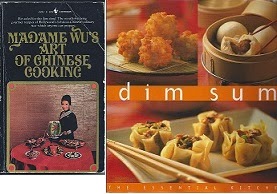
"Madame Wu's Art of Chinese Cooking" & "Dim Sum" - for the Chinese New Year


Date I made these recipes:  February 13, 2014 (for the Chinese New Year)

Madame Wu's Art of Chinese Cooking by Sylvia Wu
Published by:  Bantam Books Inc.
© 1973, 1975; 9th printing October 1981 (paperback)
Recipe:  Barbecued Pork - p. 29, used in Barbecued Pork with Vegetables – p. 146
Purchased at Falling Rock Cafe, Munising, MI

Dim Sum - The Essential Kitchen by Vicki Liley
Published by:  Periplus
ISBN:  13: 978-962-593-528-7
Recipe:  Snow pea Shoot Dumplings – p. 52
Purchased at Arc's Value Village Thrift Stores, Richfield, MN

Good thing for me (and you) that the Chinese New Year lasts 15 days because I came in just under the gun. What can I say?  Sometimes, the schedule just goes off-road for a little bit but with 15 days at my disposal, I figured "I got this."

What I've also "got" is a rather warped sense of humor when it comes to book titles.  When my husband and I are feeling down, we often say to each other that we're kind of "woo."  So the minute I saw this book title, Madam "Wu's" Art of Chinese Cooking, I had to have this book.  Had to.  It did not disappoint.

If you Google Madame Sylvia Wu, you'll find that her website refers to her at the "Legendary" Madame Wu; that she opened her first restaurant on Wiltshire Boulevard in Santa Monica in 1959; that she entertained Hollywood's top dignitaries (she's pictured with the legendary Cary Grant on her book's back cover) and that she authored four cookbooks.  That is not a shabby resume. 

I liked Madame Wu's book a lot because it was pretty comprehensive.  There are several recipes in each category – Appetizers; Soups; Seafood; Chicken; Duck; Beef; Pork and so on, plus instructions on tea, where to shop, what to buy and even Chinese wines.  I decided on the barbecued pork simply because I like Chinese barbecued pork but had never made it.  But you should know that in order to make the Barbecued Pork with Vegetables, you will need to make the barbecued pork ahead of time and you will also need to reserve at least four hours for it to marinade.

To accompany the pork and vegetables, I pulled out a book titled – quite simply – Dim Sum.  Here, you can have your pick of recipes for steamed dumplings, fried dumplings, egg rolls, steamed pork buns (tempting, except I already decided on the barbecued pork) and other delectable goodies suitable for snacking.  I let my husband, Andy, make the final selection and he decided on the snow pea (and shrimp) dumplings and dang, they were yummy.  The sweetness of the snow peas and shrimp was perfect and was a great contrast to the tangy barbecued pork.

Now, as I mentioned the pork recipe calls for marinating at least four hours and then cooking the tenderloin in the oven and then adding it to the wok along with the other vegetables for the complete dish.  Well.  I thought I could pull off the marinade, tenderloin cooking and wok all in one night but I was running behind schedule and was feeling the stress.  And so when my poor husband came in and said "What time do you think we'll eat?"  I about bit his head off and served it back to him on a platter.  I know he was only asking because if dinner would be late, he'd have a snack.  I suggested – quite strongly – that he have a snack.  Quite strongly.  In the end, I made the pork tenderloin, wrapped it in foil and put it in the refrigerator for dinner the next day.

When the "next day" rolled around, I enlisted my man's help with the dumplings.  He has a nice touch with those kind of things and so he made the prettiest dumplings (after I combined all the ingredients) and I got to work on the main course.  And so together we made our meal, a rarity in our house, and the tension of the day before went away...and we were "woo" (or "wu") no more.

Barbecued Pork  - serves 4 (Note:  requires 4 hours or more of marinade time)
1 1-pound pork tenderloin, cut in two strips
¼ cup dark Chinese soy sauce
1 teaspoon light Chinese soy sauce
3 tablespoons catsup
1 teaspoon sugar
3 tablespoons Hoisin sauce
2 cloves garlic, crushed
1 tablespoon red wine

Make a marinade of soy sauces, catsup, sugar, Hoisin sauce, garlic and red wine and marinate the pork overnight, or for a minimum of 4 hours.

Preheat oven to 350F.  Place marinated pork strips on oven rack, with pan underneath to catch the drippings.  (Ann's Note:  Unless you want a messy oven, I suggest you skip this part and use a broiler pan instead.  Much easier to clean!)  After 20 minutes, lower the heat to 300F and brush both sides with the marinade and barbecue 20 minutes.  Brush both sides again, turn over and barbecue 15 more minutes.  Brush, turn over, and complete barbecuing after 15 minutes.

Remove from the oven.  (Ann's Note:  Proceed to the recipe below for Barbecued Pork with Vegetables.)  If pork is to be served as an appetizer, cut into thin strips.  If main course, cut into larger pieces.

Barbecued Pork with Vegetables – serves 4
3 tablespoons vegetable oil
1 ¼" slice ginger root
1 cup Chinese cabbage (use the tender center, wash thoroughly and cut into 2" lengths).  (Ann's Note:  Chinese cabbage is also known as Napa cabbage.)
½ cup chicken broth (or water) (Ann's note:  divide the broth; you will use ¼ now, ¼ later.)
½ pound snow peas (pull strings)
½ cup canned whole button mushrooms
½ cup canned thin-sliced bamboo shoots
½ cup canned thin-sliced water chestnuts
2 teaspoons salt
¼ teaspoon monosodium glutamate (optional)
1 tablespoon thin-sliced green onions with stems
1 pound barbecued pork, thin-sliced
1 ½ teaspoons cornstarch

Add 2 (out of 3) tablespoons of oil to a preheated wok over high heat.  Swirl ginger root around bottom and sides, then discard the ginger.  Add Chinese cabbage and stir-fry for 2 minutes, then add ¼ cup broth.  Cover and cook for 1 minute.  Uncover and add the pea pods, mushrooms, bamboo shoots, water chestnuts, salt and MSG (if desired).  Stir thoroughly for 1 minute.  Spoon into a bowl and set aside.

Clean the wok, preheat and add 1 tablespoon oil.  Add the thin-sliced onion and the barbecue pork; stir-fry a few seconds.  Add the vegetables and mix well.  Blend the cornstarch with the remaining ¼ cup of broth and stir evenly into the mixture.  Using a slotted spoon so that the liquid remains in the wok, remove the pork and vegetables to a platter and serve immediately.  (Ann's Note:  I served this over rice.)

Snow Pea Shoot Dumplings – makes 15
4 oz fresh snowpea shoots, roughly chopped  (Ann's Important Note:  I could not find snowpea shoots so I used snowpeas instead and just made sure I chopped them so that they would fit inside a wonton wrapper.  We still loved this recipe.)
4 oz (raw) jumbo shrimp, peeled, deveined and coarsely chopped
2 teaspoons peeled and grated fresh ginger
3 teaspoons oyster sauce
1 teaspoon soy sauce
1 teaspoon rice wine
¼ teaspoon salt
½ teaspoon sugar
1 teaspoon Asian sesame seed oil
1 tablespoon cornstarch
15 wonton wrappers (round or square)

Blanch snowpea shoots (or snow peas) in a pan of boiling water for 1 minute.  Drain and refresh immediately in cold water.

In a bowl, combine snowpea shoots, shrimp, ginger, oyster sauce, soy sauce, rice wine, salt, sugar, sesame oil and cornstarch.  Using wet hands, mix until well combined.  (Ann's Note:  I used a spoon to mix and it worked just fine.)

Place wonton wrappers on work surface and cover with a damp kitchen towel.  Working with one wrapper at a time, place 3 teaspoons of filling in the center and brush edges of wrapper with water.  Fold three sides of wrapper into the center, forming a triangular shape.  Using your fingertips, press edges of wrapper together.  Cover with a damp kitchen towel and set aside.  Repeat with remaining wonton wrappers.

Line a medium bamboo steamer with parchment (baking paper).  Ann's Note:  we don't have a bamboo steamer but we do have a large fry pan that has a steamer tray so we used that (it sort of makes for a large double-boiler).  You can also use a metal steamer that you insert into a pan; just be sure to avoid getting the dumplings wet.

Once you line your steamer with parchment, half fill a medium wok (steamer pan) with water and bring to a boil.  Arrange dumplings in steamer, cover and place steamer over boiling water.  (Again, do not get the dumplings wet).  Steam for 10 minutes, adding more boiling water to pan when necessary.  Lift steamer off pan and carefully remove dumplings.  Serve warm with soy sauce.